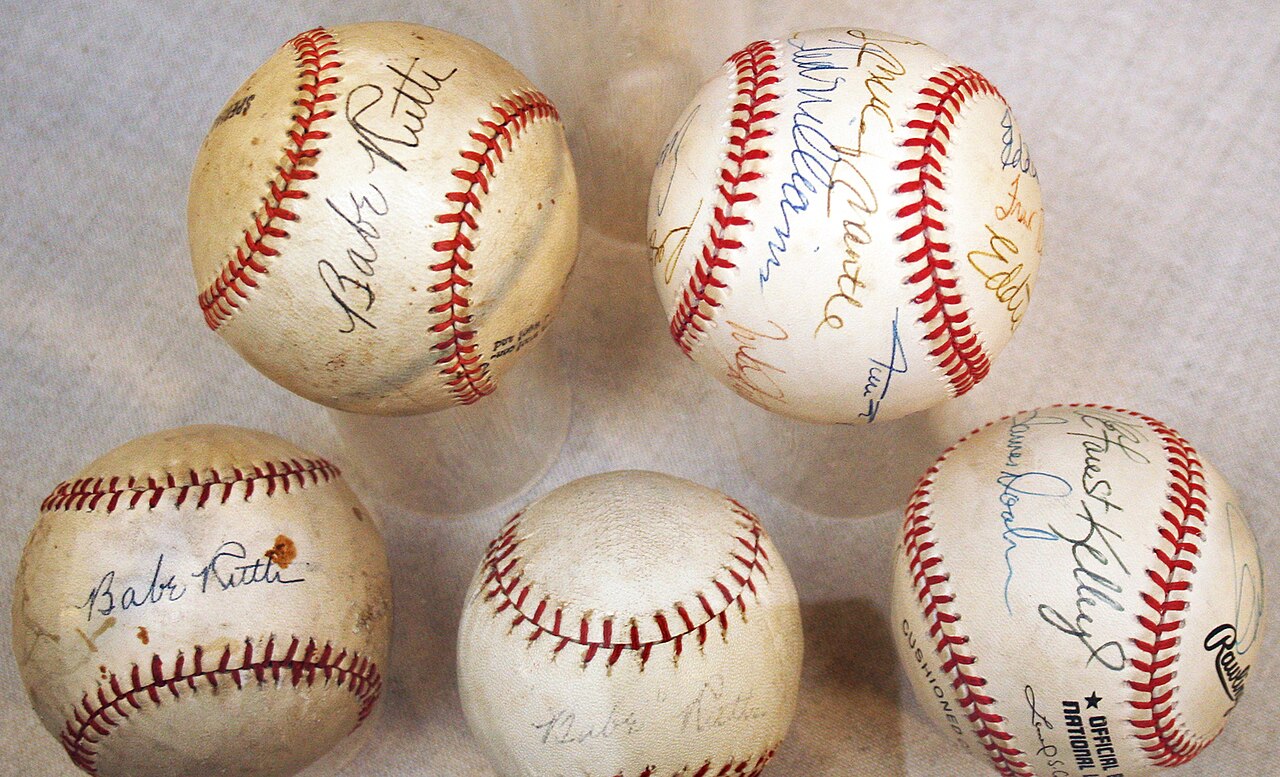
The baseballs look like objects a collector might treasure: worn surfaces, familiar red stitching, the name of a player whose career belongs to another age. But the FBI identifies the balls in its artifact photograph as forgeries recovered in Operation Bullpen. The signatures purporting to be Babe Ruth’s were part of a market in manufactured connections to famous people. [3]
Case brief
San Diego / Oceanside, California · 1997–2005
- Recorded outcome
- FBI’s 2005 overview reported 63 charges and convictions and 18 forgery rings dismantled. Counts and values are dated agency totals, not one defendant’s judgment.
Key moments
Case photographs
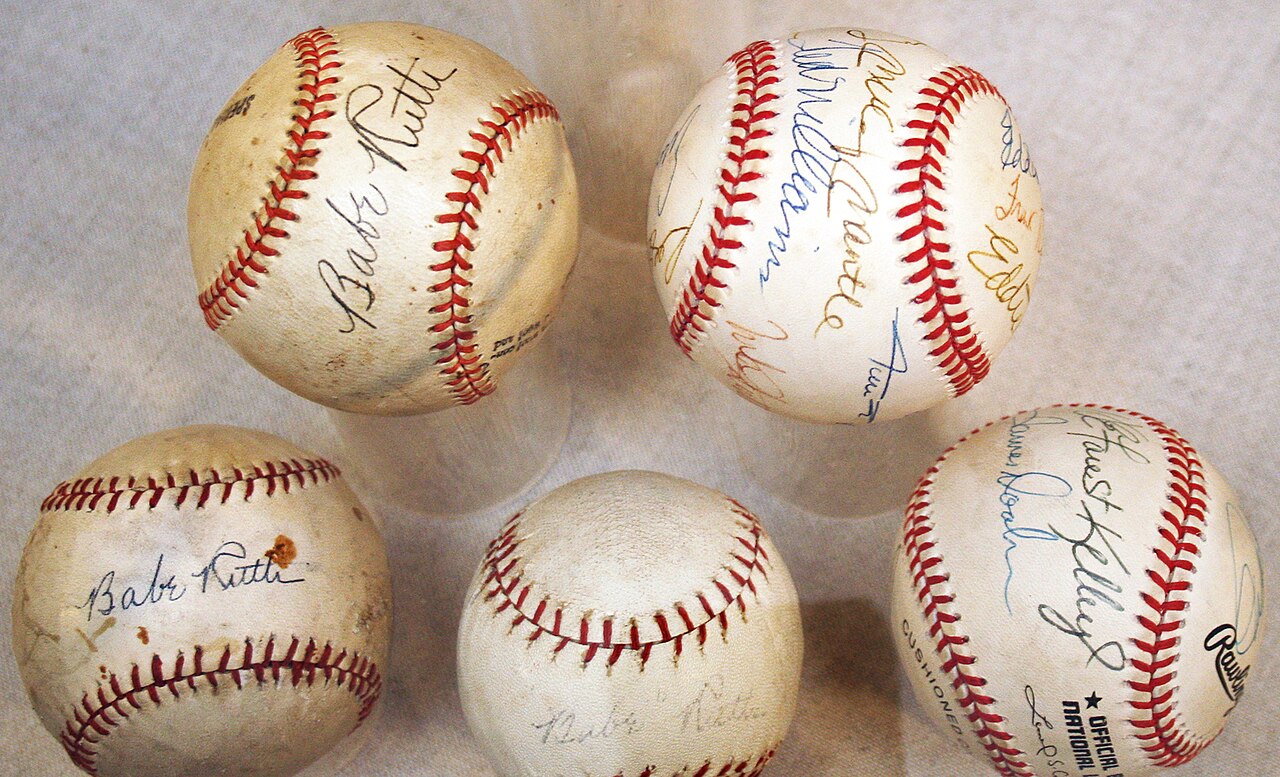
Recovered forged baseballs Baseballs with forged Babe Ruth signatures recovered in Operation Bullpen.
Evidence photograph · Federal Bureau of Investigation · U.S. public domain
The investigation’s most revealing evidence was not simply how those signatures looked. Undercover recordings captured people discussing their knowing involvement in forging, authenticating, and distributing false memorabilia. A certificate could be made to reassure a customer. A seller’s recorded admission could expose what that reassurance was worth. [1][4]
What began with a Chicago investigation into counterfeit sports autographs expanded into a nationwide operation involving the FBI, federal prosecutors, and the IRS. The case reached beyond baseball to actors, musicians, and historical figures. It exposed an entire chain of trust: not only the hand that wrote a false name, but the businesses and stories that helped sell it as genuine. [1][4]
Federal Bureau of Investigation (FBI) · Image source · Public domain · Commons-provided resized image; no content edits.


The appeal of an object with a story
An ordinary baseball can acquire a different meaning when someone says a particular player signed it. The object remains physically similar, but the claimed connection changes its significance to a fan. A signature offered as Babe Ruth’s sells a link to someone a modern buyer cannot meet. A framed celebrity photograph may promise a similarly personal connection to a screen performance or a piece of music.
Operation Bullpen targeted the exploitation of that trust. The FBI described a network of forgers, authenticators, wholesalers, and retailers. Its reports distinguished knowing participation from the possibility that an authenticator could mistakenly certify something false. That distinction matters: discovering a fake in a shop does not automatically prove that every person who handled it knew it was fake. Establishing knowledge was one reason investigators pursued conversations and transactions as well as objects. [1]
The investigation also challenged the assumption that a convincing document necessarily comes from an independent authority. A certificate of authenticity could accompany an item through the same commercial chain that supplied the forgery. If the certificate’s issuer was implicated, the paper did not provide the independent check its presentation suggested. More pieces of paper could amplify a claim without improving its foundation. [1]
Chicago supplies the first lead
In the mid-1990s, the FBI’s Chicago office investigated forged memorabilia associated with local sports stars, including Michael Jordan. That investigation, called Operation Foul Ball, led to convictions in several states. The geographical spread pointed toward a wider problem than a single neighborhood seller copying a few signatures. [1][4]
In 1997, the San Diego office used information from that investigation and other sources to begin Operation Bullpen. The IRS joined the effort because the proceeds created financial questions: where the money went, how it was recorded, and whether the participants reported it. The investigation therefore had two connected subjects—the claims made about the goods and the money those claims generated. [1][4]
It would be misleading to treat all the names in an early investigative release as people already convicted when the release appeared. The archived April 2000 account described impending charges and a continuing investigation. Later FBI summaries supply later conviction totals. This story keeps those dates attached, so an accusation at one stage is not silently converted into a judgment from another. [1][2][4]
A trading company that was really an investigation
The FBI established the Nihon Trading Company in Oceanside, California, as part of an undercover operation. An agent posed as a distributor taking American memorabilia to Asia. According to the agency’s account, that arrangement allowed investigators to buy evidence without selling counterfeit goods onward to unsuspecting members of the public. [1][4]
The purported overseas market also affected how participants spoke. The FBI reported that some were more open about the counterfeit nature of their stock because they believed it was headed beyond the practical reach of U.S. authorities. Those statements gave investigators evidence about knowledge and intent that a disputed signature alone could not supply. [1]
The operation accumulated more than a thousand recorded audio and video conversations during its first phase. The number conveys scale, but it should not become a shorthand for a thousand confessions. Recordings are investigative material whose content, speakers, and relevance still have to be assessed. The FBI specifically identified incriminating statements within that material as key evidence of knowing participation. [1][4]
One episode in the agency’s account captures how the investigation moved beyond purchasing objects. Participants grew suspicious and met for breakfast in Carlsbad to discuss possible law-enforcement attention. Agents seated nearby overheard the conversation. Even the participants’ efforts to assess the threat had become part of the investigation, according to the FBI’s account of the encounter. [1]
The athletes become witnesses
Tony Gwynn and Mark McGwire assisted the investigation by identifying forged versions of their own autographs. Their involvement supplied leads about people handling counterfeit goods. The significance was practical: the people whose names were being sold could help investigators challenge claims made in their name. [1]
An athlete’s recognition that a signature is wrong is valuable information, but the broader case did not depend solely on a celebrity pointing at an object. Investigators connected goods to suppliers and transactions, recorded discussions, and followed proceeds. That combination helped separate a dispute over an autograph’s appearance from evidence of a business knowingly selling false claims. [1]
Laboratory examination supplied another perspective. In a later FBI presentation, a questioned-documents examiner explained that materials such as the ink and the objects themselves could be relevant to whether a purported historical autograph was possible. The lesson is broader than handwriting resemblance: the physical object has a history that can be checked against the story attached to it. [6]

User:JDrewes see www.jandrewes.de · Image source · CC BY-SA 3.0 · Commons-provided resized image; no content edits.

The October raids
On October 13, 1999, FBI and IRS agents executed approximately 60 search warrants at homes and businesses in five states: California, New Jersey, Nevada, Pennsylvania, and Florida. More than 400 agents participated, according to the FBI’s April 2000 account. The operation seized cash and a large quantity of memorabilia, including thousands of baseballs bearing forged signatures. [1]
The agency estimated roughly $10 million in seized forged memorabilia and more than $500,000 in cash at that stage. These figures describe different things. The alleged retail value of counterfeit stock is not the same as money recovered, money already paid by victims, or restitution later ordered and collected. Adding them together would produce an impressive number with no clear meaning. [1]
The variety of material also broadened the story. The FBI listed sports equipment, photographs, posters, clothing, and pieces of paper bearing supposed signatures of long-dead public figures. Its examples extended from baseball players to presidents and entertainers. The criminal proposition was portable: attach a scarce person’s name to an ordinary object, then persuade a buyer that the connection was real. [1]
The second phase follows the market
The first phase culminated in April 2000 with charges against 26 individuals, whom the FBI later reported were all convicted. Further investigations drew on cooperating participants, industry assistance, and the relationships exposed in the first phase. The operation expanded beyond its initial Southern California concentration. [4]
The later work paid particular attention to celebrity photographs and online sales. According to the FBI, sellers often explained their stock by saying “runners” had obtained autographs through encounters with celebrities. The investigation found instances in which limited genuine access was used to support claims about much larger quantities of material. The claimed history of an item could be counterfeit even when the seller had genuinely met the celebrity. [4]
The agency’s October 2003 update reported 26 convictions from the first phase and 16 from the second at that point. Its 2005 overview reported a larger second-phase total and 63 charges and convictions overall. Those are dated agency snapshots, not competing numbers that can be used interchangeably. The later overview also reported 18 forgery rings dismantled. [2][4]
The published figures are not a substitute for the judgment in any individual defendant’s case. This article therefore focuses on the documented operation and its evidence rather than assigning every person listed in an early release a sentence or final outcome that has not been individually checked. The larger story can be told accurately without flattening separate prosecutions into one verdict. [1][4]
What the totals cannot tell us
The early FBI accounts quoted broad estimates about the share of the memorabilia market believed to be forged. Those estimates came from industry participants and cooperating sources. The agency itself acknowledged the difficulty of measuring the percentage definitively. They are evidence of the concern surrounding the market at the time, not a reliable probability that a particular autograph offered today is fake. [1][4]
The 2005 overview also reported more than $300,000 in restitution paid to more than a thousand victims, along with assets seized and a separate estimate of economic loss prevented. Restitution paid is a concrete measure with a different meaning from the projected value of goods intercepted. Keeping those categories separate shows both the reach of the operation and the limits of what its headline figures establish. [4]
There is a human cost inside those categories. A buyer may lose money, but also the meaning attached to a supposed gift or keepsake. Legitimate sellers and genuine signed objects can suffer from the distrust created by counterfeit stock. Operation Bullpen’s record describes a commercial crime whose product was not simply ink on a ball. It was a claim about history that someone else paid to believe. [1][4]
A different kind of proof
MLB began its authentication program in 2001. It uses witnessed signing or game use, identifiers, and records to document eligible objects. [5]
That approach addresses a question the Bullpen cases made unavoidable: who can independently support an object’s claimed history? A document from a seller is different from a record created by someone who actually observed the relevant event. The FBI’s later overview discussed witnessed authentication as an industry response, while its original investigation had shown how certificates and photographs could be used to lend false credibility. [1][4]
The real artifact photograph in this article offers a final reversal. These particular baseballs are valuable to the story because their signatures are false. Properly identified and preserved, they document a crime instead of carrying it forward. Beside them, the gallery diagrams explain the recorded admissions, the distribution chain, and the different meanings of the reported totals. The photographs and illustrations are individually labeled, so no explanatory image quietly acquires the authority of an original exhibit.
Look closer · 8 visuals
Inside the evidence.
Open a visual to explore what it contributed to the case—and the limits of what it shows. Photographs, historical reproductions and original illustrations are individually labeled. Open the notes for each image’s source, credit, and limitations; setting photographs do not depict crime scenes.
The chain that sold credibility
Original editorial illustration — not an actual evidence photograph or exhibit.
Read the evidence notes
The FBI investigated connected roles in making, certifying and selling counterfeit memorabilia.
A false item in a shop does not alone prove that every handler knowingly joined the crime.
The trading-company cover
Original editorial illustration — not an actual evidence photograph or exhibit.
Read the evidence notes
Nihon Trading Company was the undercover vehicle described in FBI accounts.
This is an explanatory diagram, not a reproduction of business stationery or an operational guide.
Knowledge captured on recordings
Original editorial illustration — not an actual evidence photograph or exhibit.
Read the evidence notes
The FBI identified recordings of knowing involvement as key evidence of the fraud.
More than a thousand recordings does not mean more than a thousand confessions.
A certificate is a claim
Original editorial illustration — not an actual evidence photograph or exhibit.
Read the evidence notes
The investigation exposed certificates that did not provide the independence buyers assumed.
Generic diagram; not a reusable certificate template or a claim that all certificates are false.
Three different money measures
Original editorial illustration — not an actual evidence photograph or exhibit.
Read the evidence notes
The 2005 overview reported these separately. Each answers a different question about the operation’s effect.
Do not add the figures as though they measure the same thing or equate estimates with court-proven loss.
An expanding prosecution
Original editorial illustration — not an actual evidence photograph or exhibit.
Read the evidence notes
The operation developed over several years and included multiple prosecutions.
Totals are dated FBI reports, not a single joint verdict against everyone ever named.
Recovered forged baseballs
Actual recovered artifacts, photographed by the FBI.
Read the evidence notes
Actual case artifacts: baseballs bearing forged Babe Ruth signatures recovered in Operation Bullpen, photographed and published by the FBI. These are forgeries, not genuine Ruth autographs.
Commons-provided resized image; no content edits. The source and reuse license are linked below.
Source 3 ↗ · Federal Bureau of Investigation (FBI) · Image source · Public domain
San Diego’s skyline viewed from Coronado in November 2007
Geographic context photograph — not a crime-scene image.
Read the evidence notes
San Diego’s skyline viewed from Coronado in November 2007. Geographic context for the FBI investigation; not an undercover-operation photograph.
Commons-provided resized image; no content edits. The source and reuse license are linked below.
User:JDrewes see www.jandrewes.de · Image source · CC BY-SA 3.0
★ Key evidence used in a conviction · ✓ Exclusion or reversal · ◇ Disputed evidence · ⊘ Excluded at retrial · ◆ Identity / investigative finding, not a conviction. A symbol does not mean one item proved the whole case.
Follow the locations
Put the story on the map.
Follow the dated entries, then select an event to find its regional setting. Shared-location pins open a group of events. Evidence symbols identify important findings and their limitations.
Open the map in its own window ↗Sources & further reading
- Operation Bullpen — FBI San Diego investigative accountUndercover company, recordings, athletes, October 1999 searches and contemporary estimates.
- Operation Bullpen: America’s National Pastime — FBIDated phase-one and phase-two conviction counts.
- Babe Ruth Baseballs — FBI artifact collectionIdentification of actual recovered forged baseballs; photograph separately licensed as a federal work via Commons.
- Operation Bullpen Overview — FBIExpanded phases, 63 overall charges and convictions, restitution and seizure categories.
- MLB Authentication — official program informationProgram began in 2001; witnessed signing or use and identification records.
- Inside the Questioned Documents Unit — FBI transcriptMaterial dating and document examination; loose spoken chronology not used to override the 1997 launch in contemporaneous history.
Editorial review: 2026-09-30 · 1738 words