On August 4, 1980, Rolf Neslund wrote to family in Norway about their planned visit to the United States that autumn. A few days later, he disappeared from the life they expected to share with him. His wife, Ruth, later testified that he had left their Lopez Island home on August 14, saying he was going to Norway. Yet his Norwegian relatives had heard nothing from him since before the disappearance. [1]
Case brief
Lopez Island / Friday Harbor, Washington · 1980
- Recorded outcome
- Ruth Neslund convicted of first-degree murder in 1985; conviction affirmed in 1988. Sentenced to 20 years to life; died in prison in 1993.
Key moments
People and case photographs
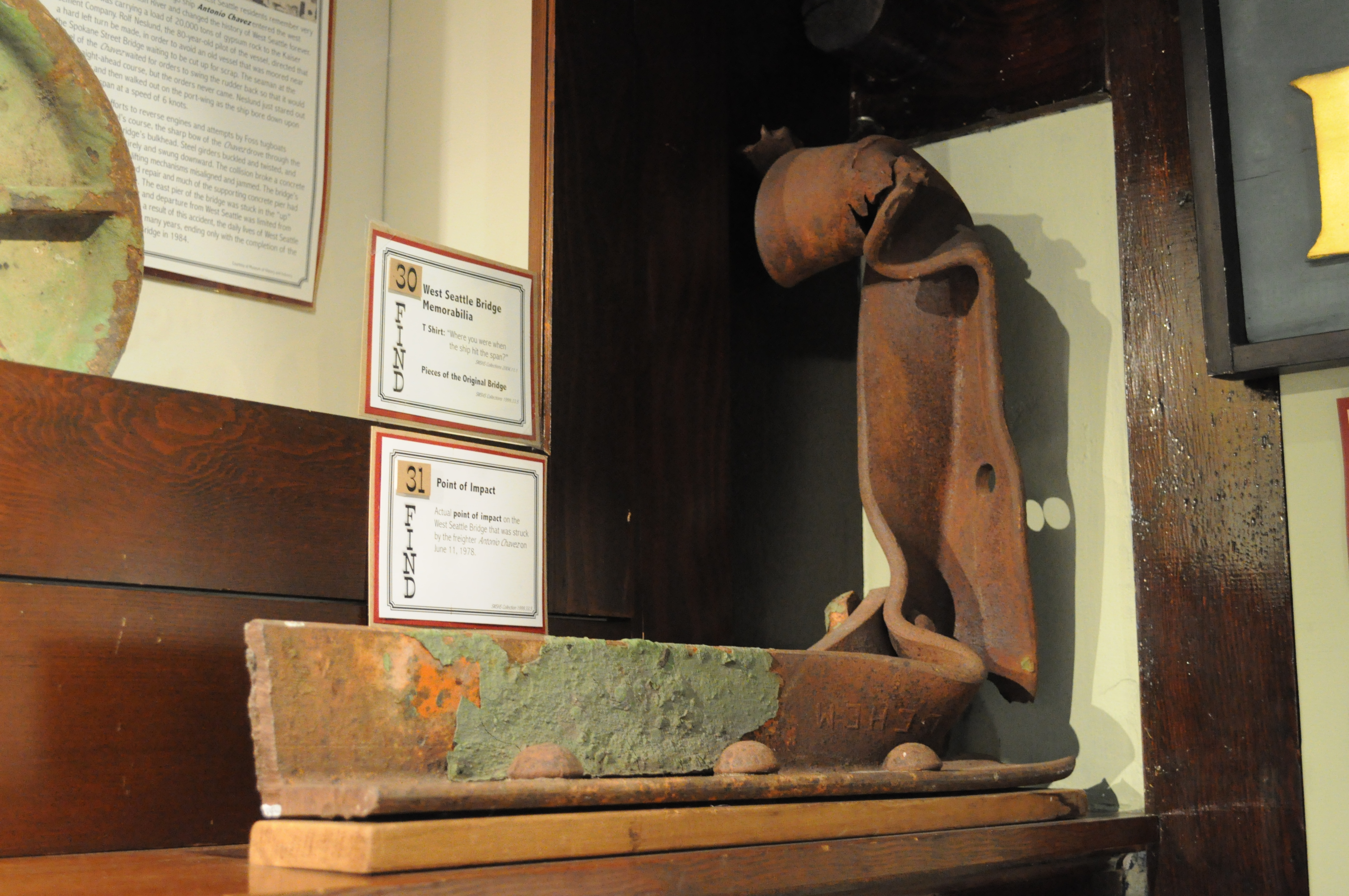
Steel from the 1978 bridge collision A damaged section of the old West Seattle Bridge on display at the Log House Museum in 2009. Rolf Neslund was the pilot aboard the freighter Chávez when it struck the bridge.
Museum artifact photograph · Joe Mabel · CC BY-SA 3.0- Rolf Neslund
Murder victim and ship pilot
Photo at source · HistoryLink · archival case photograph - Ruth Neslund
Convicted of murdering Rolf Neslund
Photo at source · HistoryLink · archival case photograph
The gap between those two versions—an anticipated family visit and an unexplained departure—became part of a murder case without a recovered body. Prosecutors eventually presented financial records, blood evidence, changes inside the home, and witnesses who said Ruth had admitted killing her husband. Ruth denied the killing. A jury convicted her, and the Washington Court of Appeals affirmed in 1988. [1]
The case has accumulated lurid stories over the years. The documented investigation is compelling enough without repeating them. Its central problem was formidable: before asking jurors to decide who killed Rolf, the state had to establish that his absence was the result of a crime at all. [1]

Compdude123 · Image source · CC BY-SA 3.0 · Commons-provided resized image; no content edits.

An island home, an increasingly fractured marriage
Rolf was a retired maritime pilot whose name was already familiar in the Seattle area because of a 1978 ship collision with the West Seattle Bridge. By the time of his disappearance, his life was centered on Lopez Island in the San Juan Islands. That public history helps explain the attention the case attracted, but it did not explain what happened inside his marriage. [2]
The trial record described violence and growing hostility between Rolf and Ruth. Witnesses recounted threats. A deputy had responded to a domestic incident in June 1980. Relatives and friends described statements indicating that Rolf feared his wife. The appeal considered those accounts alongside physical and financial evidence, rather than treating a difficult marriage as proof that a murder must have occurred. [1]
Money was another recurring point of conflict. Records showed funds moving from joint arrangements into accounts in Ruth’s name. The appellate opinion distinguishes particular transactions, including a $50,000 money-market certificate redeemed and reissued in her name in June 1979. Witness testimony also described an argument over retirement money. These were related strands, but the different amounts should not be carelessly merged into one supposedly definitive theft. [1]
The significance of the transactions was the prosecution’s inference about motive and conflict. A transfer alone cannot prove murder, and the financial record does not give a reporter access to every conversation between the couple. At trial, however, it gave jurors something external to compare with witnesses’ accounts of arguments over money and with Ruth’s explanation of Rolf’s disappearance. [1]
A letter, a missed meeting, and silence
The August 4 letter was a modest piece of evidence. It did not describe a crime or predict one. It showed Rolf anticipating a visit from his brother and sister-in-law, offering a point of comparison with the claim that he suddenly left for Norway. A planned social contact also went unfulfilled. When investigators examined his disappearance, these ordinary expectations became important. [1]
People can change plans. They can leave marriages, travel unexpectedly, or stop contacting relatives. The state therefore needed more than a missed appointment and an unanswered letter. But the absence continued. Gunnar Olsborg, a retired pilot and friend, contacted the sheriff’s office in January 1981 and placed newspaper advertisements offering a reward for information. Those efforts did not locate Rolf. [1]
Ruth’s account put him alive and departing on August 14. Several prosecution witnesses described an entirely different chronology. Her niece Joy Stroup testified that Ruth telephoned on August 8 and said she had shot Rolf during a confrontation. Another brother, Paul Meyers, testified about admissions Ruth made during later visits and conversations he overheard between Ruth and their brother Robert. [1]
The dates matter. August 8 was the date tied to the alleged killing in witness accounts. August 14 was the date Ruth gave for a departure she maintained had occurred. The timeline below labels the latter as her account, not as a verified journey to Norway. An interactive map should not turn a rejected explanation into a travel route simply because a place name appears in the record. [1]
What the house could tell investigators
Inside the home, investigators found evidence that complicated a voluntary-disappearance theory. The appellate opinion describes blood on a trunk behind the living-room couch, traces elsewhere in the house, and material recovered from the ceiling. Some blood was identified as human; some was classified as type A, Rolf’s blood type. A gray hair was also described in the evidence. [1]
These were not DNA identifications. Blood-group consistency is shared by many people and does not identify an individual as modern readers may assume when they see the word “match.” The record’s significance came from the location and combination of findings, interpreted alongside other evidence. The gallery therefore labels blood typing as a limitation rather than presenting a fingerprint-like identification graphic. [1]
The state also called witnesses about changes to the house. Ruth replaced the couch shortly after the alleged killing. Parts of the carpet were replaced, a portion of the concrete floor was treated with an etching material, and the living-room ceiling was later refinished. In the appeal’s account, blood was found in areas of the ceiling that had not been resurfaced. [1]
Home renovation is ordinary conduct. Here, prosecutors argued that its timing and relationship to blood evidence suggested an effort to remove traces of a violent event. That was an inference supported by the trial record, not an automatic rule that a replaced couch proves concealment. The distinction becomes especially important in a case with no recovered remains to independently establish a cause of death. [1]
The gun and its limits
A search in March 1982 recovered a .38-caliber Smith & Wesson handgun from a bedroom drawer. A criminalist testified about tiny blood traces he observed and tested on the gun. Another expert interpreted patterns in the house as consistent with gunshots near the couch. The court allowed the handgun into evidence, finding that the witnesses and physical findings made it relevant. [1]
Ruth challenged that ruling. The defense presented an account that she had acquired the gun in December 1980, after the alleged murder. The state disputed that chronology. The opinion also records a separate controversy over a gun-transfer receipt that was initially admitted and then excluded. Those are meaningful complications: the prosecution did not present an uncontested purchase date followed by a recovered bullet conclusively tied to a body. [1]
The appellate court upheld the handgun’s admission. Relevance, however, is a lower and different question from proving that a particular object was the murder weapon. The blood-pattern interpretations were testimony given at that trial; they should be reported as such, without converting the experts’ “consistent with” conclusions into a newly verified reconstruction of the shooting. No body or ballistic recovery supplied that missing certainty. [1]

Bureau of Land Management Oregon and Washington from Portland, America · Image source · Public domain · Commons-provided resized image; no content edits.


The witnesses were not interchangeable
Stroup’s testimony concerned what she said Ruth told her directly. Paul Meyers recounted both direct admissions and discussions involving Robert in Ruth’s presence. Winnifred “Winnie” Stafford, a friend, testified that Ruth had admitted the killing to her on the evening of August 8. Stafford also acknowledged that she had previously lied under oath when denying such an admission. [1]
That prior false statement was a serious credibility issue. It did not disappear because her later account supported the prosecution. Jurors had to consider why the account changed and whether to believe it. A careful narrative cannot resolve the problem by calling every witness statement a confession, as if each were an authenticated recording in Ruth’s own voice. These were witnesses reporting conversations. [1]
The overheard discussions raised an additional legal question. Some statements were Robert’s words, which prosecutors argued Ruth had adopted by failing to contradict him in the circumstances described. The Court of Appeals considered whether there was sufficient evidence that she heard the statements and was able to respond. It also warned, in explaining the governing rule, that silence can be ambiguous. [1]
The court upheld admission of that testimony on the record before it. This was not a general ruling that declining to answer police, or remaining silent whenever accused, proves guilt. Nor did Ruth’s conviction constitute a verdict against every person named in a witness’s account. Robert’s alleged participation remains attributed testimony in this story; HistoryLink’s retrospective reports that he was not charged. [1][2]
Proving a death without producing a body
The legal expression at the center of the appeal was corpus delicti. Despite the word “corpus,” it does not mean a homicide prosecution always requires a physical body. The rule discussed by the Washington court required independent evidence supporting the occurrence of a death caused by criminal means before out-of-court admissions could carry the case. Its purpose was to guard against convictions resting on a false confession alone. [1]
The court distinguished that preliminary evidentiary threshold from the jury’s ultimate task of deciding guilt beyond a reasonable doubt. For the threshold question, it considered the blood-tainted evidence, the changes in the house, the relationship’s violence, financial transfers, Rolf’s expressions of fear, and his unexplained disappearance. Taken together, it found enough independent support to permit consideration of the reported admissions. [1]
This is the case’s most important evidentiary turn. The witnesses’ accounts did not stand in isolation. Conversely, the blood traces did not identify Ruth as the killer by themselves. The record worked through corroboration: evidence that a crime occurred supported consideration of the admissions, and those admissions were assessed alongside the surrounding circumstances when jurors decided responsibility. [1]
The verdict and what remained absent
In December 1985, the jury found Ruth Neslund guilty of premeditated first-degree murder. The Court of Appeals affirmed on February 8, 1988. HistoryLink records that she received a sentence of 20 years to life and died in prison in 1993. The disappearance had become a proven murder in court, but the proceedings had not produced Rolf’s body. [1][2]
That unresolved physical absence is part of the ending. A conviction answered the question of criminal responsibility; it did not provide every answer a family might want about the missing person. The most durable evidence in the account is not a sensational legend about disposal. It is the accumulation of smaller, testable things: a letter about an upcoming visit, bank transactions, a room’s altered surfaces, traces examined in a laboratory, and statements witnesses were required to defend under questioning.
The modern island photographs accompanying this story provide setting, not proof. None shows the Neslund home, a crime scene, or a recovery location. The map uses regional reference points and keeps the conflicting August accounts separate, so the geography supports the record instead of filling its gaps with imagined precision.
Look closer · 10 visuals
Inside the evidence.
Open a visual to explore what it contributed to the case—and the limits of what it shows. Photographs, historical reproductions and original illustrations are individually labeled. Open the notes for each image’s source, credit, and limitations; setting photographs do not depict crime scenes.
The letter before the silence
Original editorial illustration — not an actual evidence photograph or exhibit.
Read the evidence notes
Rolf’s letter to family in Norway supported expectations inconsistent with a wholly unexplained disappearance.
A letter alone cannot prove a death or establish who caused it.
Two August accounts
Original editorial illustration — not an actual evidence photograph or exhibit.
Read the evidence notes
Witnesses placed reported admissions on August 8; Ruth said Rolf left for Norway on August 14.
The claimed trip was not verified. The graphic does not plot a journey.
A room’s changing surfaces
Original editorial illustration — not an actual evidence photograph or exhibit.
Read the evidence notes
The court evaluated changes inside the home with blood-tainted material recovered by investigators.
No floor plan is reproduced. Renovations acquire significance from context, not from their existence alone.
Blood type is not identity
Original editorial illustration — not an actual evidence photograph or exhibit.
Read the evidence notes
Some recovered blood was human and type A, consistent with Rolf’s blood group.
Many people share a blood type. Trial expert interpretations are not a unique identification.
Witnesses and admissions
Original editorial illustration — not an actual evidence photograph or exhibit.
Read the evidence notes
Stroup, Meyers and Stafford described different conversations; Stafford admitted earlier false testimony.
These are recollections, not audio recordings. Allegations about Robert are not a verdict against him.
The two questions for the court
Original editorial illustration — not an actual evidence photograph or exhibit.
Read the evidence notes
Independent evidence supported considering reported admissions; jurors still had to determine guilt beyond a reasonable doubt.
The preliminary corpus-delicti threshold differs from the ultimate trial burden.
The ferry Elwha passing Flat Point on Lopez Island
Geographic context photograph — not a crime-scene image.
Read the evidence notes
The ferry Elwha passing Flat Point on Lopez Island. Later geographic context; no claim that this vessel carried anyone in the case.
Commons-provided resized image; no content edits. The source and reuse license are linked below.
Compdude123 · Image source · CC BY-SA 3.0
Iceberg Point on Lopez Island, photographed by Jeff Clark for the Bureau of Land Management
Geographic context photograph — not a crime-scene image.
Read the evidence notes
Iceberg Point on Lopez Island, photographed by Jeff Clark for the Bureau of Land Management. Landscape context, not a recovery site; no body was produced at trial.
Commons-provided resized image; no content edits. The source and reuse license are linked below.
Bureau of Land Management Oregon and Washington from Portland, America · Image source · Public domain
Friday Harbor in an August 2009 aerial photograph
Geographic context photograph — not a crime-scene image.
Read the evidence notes
Friday Harbor in an August 2009 aerial photograph. Geographic context for San Juan County; not a photograph of the 1985 proceedings.
Commons-provided resized image; no content edits. The source and reuse license are linked below.
Jelson25 · Image source · Public domain


Steel from the 1978 bridge collision
Photograph of the preserved bridge section, taken at the Log House Museum in 2009.
Read the evidence notes
Neslund was piloting the freighter Chávez when it struck the West Seattle Bridge in June 1978. The collision had made him a familiar name in Seattle before he disappeared in 1980.
This artifact belongs to his maritime history. It does not establish what happened on Lopez Island.
Source 2 ↗ · Joe Mabel · Image source · CC BY-SA 3.0

★ Key evidence used in a conviction · ✓ Exclusion or reversal · ◇ Disputed evidence · ⊘ Excluded at retrial · ◆ Identity / investigative finding, not a conviction. A symbol does not mean one item proved the whole case.
Follow the locations
Put the story on the map.
Follow the dated entries, then select an event to find its regional setting. Shared-location pins open a group of events. Evidence symbols identify important findings and their limitations.
Open the map in its own window ↗Sources & further reading
- State v. Neslund, 50 Wn. App. 531 — Washington Court of AppealsFull court opinion: finances, letter, disappearance, blood, gun, witnesses, corpus delicti and affirmance.
- Ruth Neslund murders her husband, Rolf Neslund, on Lopez Island — HistoryLinkMaritime context, dated prosecution milestones, sentence, Robert not charged, Ruth’s 1993 death.
Editorial review: 2026-09-30 · 1781 words