The shoes were supposed to belong to someone else. A pair of men’s size-fourteen Reeboks had left bloody impressions inside a Bethesda clothing store where Jayna Murray was found dead on March 12, 2011. Her coworker Brittany Norwood was alive, bound with zip ties, and describing an attack by two masked men. The footprints seemed to offer the missing men a physical presence. But the shoes had been inside the store all along, available for customers trying on clothing. According to the record later reviewed on appeal, Norwood used them to manufacture the intruders’ tracks. [1]
Case brief
Bethesda, Maryland · 2011
- Recorded outcome
- Brittany Norwood convicted November 2011; sentenced to life without parole January 2012; judgment affirmed April 2015.
Key moments
People in this case
- Jayna Murray
Murder victim
Photo at source · Family obituary · Dignity Memorial
The case would change twice. Investigators first had to untangle a staged robbery from the killing it concealed. At trial, the central question became narrower: Norwood conceded that she had intentionally killed Murray, while contesting whether she had acted with premeditation. Understanding that change matters. The shoes helped explain the deception after the attack. Other evidence addressed what Norwood did while Murray was still alive. [1]
Farragutful · Image source · CC BY-SA 4.0 · Commons-provided image; no content edits.

A return after closing
Murray and Norwood had worked together that Friday evening at Lululemon Athletica in Bethesda, Maryland. After closing, both left. At 9:51 p.m., Norwood telephoned another sales associate, Eila Rab, saying she had forgotten her wallet. She asked for Murray’s number so she could arrange to be let back inside. Rab sent it by text. Norwood called Murray, who agreed to return. [1]
That sequence gives the beginning of the encounter an ordinary shape: a coworker asking for a small favor at the end of a shift. The court record establishes the calls and the return. It does not require an invented conversation between the women or a claim that we can know everything Murray thought as she went back. The last decision documented here is that she agreed to help. [1]
Murray’s life extended well beyond that shop. George Washington University’s memorial identified her as a 2003 graduate in international marketing and business and described her further graduate studies. Its notice remembered an alumna pursuing an education and a future, rather than reducing her to the extraordinary circumstances of her death. Those ambitions belong in the story alongside the investigation. [2]
What the neighbors heard
Shortly after 10 p.m., employees at the adjoining Apple Store heard a disturbance through the wall. The appellate account describes thudding, dragging sounds, screams, and two female voices. An employee asked a security guard to check and discussed the noise with another manager. She continued to hear the confrontation and left the Apple Store shortly after 11. [1]
These witnesses could report sounds; they could not see what was happening next door. Their testimony therefore has an important limit. It supplied evidence that the confrontation continued over time, without making them eyewitnesses to each act or establishing an exact sequence of weapons. The appellate court later emphasized that employees listened at the wall for about nine minutes when assessing evidence of premeditation. [1]
Inside Lululemon, Murray suffered a sustained attack involving several objects. The medical examiner described injuries caused by at least five weapons, including tools and implements available in the store. This account does not reproduce the injury inventory. What mattered to the legal question was the duration of the assault and the time needed to gather weapons from different locations. Those intervals gave the prosecution a basis to argue deliberation, rather than a single instantaneous act. [1]
Building a robbery around a murder
After the killing, the scene was altered. Norwood moved objects, opened the safe, and removed three money bags. She moved Murray’s car to a more distant parking lot. She used the large shoes to create bloody prints, injured herself, damaged her clothing, and tied herself with zip ties before waiting to be found. These are the findings recounted in the appellate opinion, rather than an inference drawn merely from her unusual appearance when help arrived. [1]
The staging connected several misleading signals. Disturbed merchandise could suggest a struggle with outsiders. Money removed from a safe could supply a robbery motive. Large shoeprints could imply a male participant. A surviving employee in restraints could appear to corroborate an attack on both women. Together, the details gave investigators a story to examine. [1]
The size of a shoeprint, however, is not the identity of the person who made it. Here the court’s account identifies the shoes as store property and the prints as manufactured by Norwood. The distinction is central to the gallery accompanying this story: its shoe illustration explains the record; it is not a photograph of the actual Reeboks, a measured tread comparison, or an original forensic exhibit. [1]
The morning discovery
Manager Rachel Oertli arrived shortly before 8 a.m. on March 12. The door was unlocked. Inside, lights were on and items were out of place. After calling out and hearing a moan, she left and called 911. She then asked a man waiting outside the Apple Store, Ryan Haugh, to accompany her back into Lululemon. [1]
Haugh found Murray and then saw Norwood, who was tied up and breathing. Oertli called police again. Officers and an ambulance arrived, and Norwood was taken to Suburban Hospital. A detective interviewed her there that morning and again in the afternoon. At this stage, the detective considered her a victim and was seeking information that could identify attackers. [1]
Norwood gave a detailed account of two masked men and alleged that she had been sexually assaulted. A medical examination found no evidence of sexual assault. That result should not be treated as a rule for judging other people’s reports: the finding belongs to this case and must be considered with its wider evidence. The appellate narrative describes an established fabrication supported by the investigation, not a conclusion based solely on one examination. [1]
Farragutful · Image source · CC BY-SA 4.0 · Commons-provided image; no content edits.

The car enters the conversation
Detectives spoke with Norwood at her residence on March 14. Two days later, she came to police headquarters with siblings, ostensibly to provide elimination fingerprints and hair samples. By then, Detective James Drewry considered her a suspect. He later acknowledged that the request also served to bring her in for another conversation. Norwood was not arrested that evening and left with her family. [1]
During the March 16 interview, she said she did not know what kind of car Murray drove. The next day, her siblings contacted detectives with additional information: Norwood had supposedly been forced by the attackers to move Murray’s car. Another interview was arranged for March 18. [1]
Norwood then described leaving the store alone to move the car. She said the men threatened her, watched her, and knew where she lived. She also said she had seen a police officer while moving it but had been too frightened to seek help. The point was not that every frightened person would behave in one predictable way. The investigators were examining changes within this particular account and comparing them with the physical reconstruction of the crime. [1]
What the jury was allowed to hear
The interviews generated a legal dispute of their own. Norwood sought to suppress statements, arguing that questioning had become custodial and required Miranda warnings. The trial court excluded the later portion of the March 18 interview but admitted the earlier portion and the March 16 conversation. The appellate court upheld those rulings. [1]
That split is easy to lose in a compressed retelling. A detective eventually told Norwood that he did not believe her and explained why he believed she had killed Murray. That later confrontation fell within the suppressed material. It would be misleading to present every recorded exchange as something the trial jury heard. The legal record distinguishes what happened in an interview room from what was admitted as evidence. [1]
In upholding admission of the earlier conversations, the appellate judges considered the circumstances together: Norwood arrived voluntarily with family, doors were open at various times, she moved to a restroom, and she left after the March 16 interview. The court was deciding whether those circumstances amounted to custody. It was not establishing a reliable method of identifying guilt from whether a person appeared calm or nervous. [1]
The question of premeditation
Norwood was arrested on March 18. At the eight-day trial that autumn, the jury considered first-degree premeditated murder and second-degree specific-intent murder. With the intentional killing conceded, the difference between those alternatives was the central issue. On November 2, 2011, the jury found her guilty of first-degree murder. [1]
A separate appellate argument concerned testimony about a cut on Norwood’s hand. An officer with Army medic experience had described knife injuries he had seen and the laceration he observed. The trial judge struck his initial conclusion about how Norwood’s injury occurred and instructed jurors to disregard it. The officer was permitted to describe what he saw and his previous observations. [1]
The appeals court also reasoned that any assumed error on that point would have been harmless in light of the conceded killing and the evidence of premeditation. It pointed to the sustained assault, the gathering of multiple weapons, and the sounds heard from next door. A hand injury was not a shortcut that answered the whole case. The distinction between identifying the attacker and proving the degree of murder remained essential. [1]
Aude · Image source · CC BY-SA 2.5 · Commons-provided image; no content edits.

A verdict, and the life behind it
On January 27, 2012, Norwood was sentenced to life imprisonment without the possibility of parole. Maryland’s Court of Special Appeals affirmed the judgment on April 29, 2015. The county state’s attorney’s office also maintains a collection of contemporary reports about the sentencing. These dated outcomes are the procedural record described here. [1] [3]
The investigation is memorable for its reversal: a supposed survivor became the defendant, and shoeprints apparently left by strangers became evidence of a staged scene. But the trial’s decisive issue demanded a closer look at time, conduct, and the distinction between an intentional killing and a premeditated one. The strongest account keeps those two stages separate. [1]
Murray had returned because a coworker said she needed help getting into the store. Nothing about the later deception diminishes that documented act or the education and plans she was pursuing. The gallery and map allow readers to examine the evidence and its sources. They also return the story to the person whose life ended before the fabricated robbery began. [1] [2]
Look closer · 9 visuals
Inside the evidence.
Open a visual to explore what it contributed to the case—and the limits of what it shows. Photographs, historical reproductions and original illustrations are individually labeled. Open the notes for each image’s source, credit, and limitations; setting photographs do not depict crime scenes.
The return call
Original editorial illustration — not an actual evidence photograph or exhibit.
Read the evidence notes
Rab supplied Murray’s number after Norwood said her wallet was inside the closed store. Murray agreed to return.
The call sequence does not record every conversation or establish an exact moment when an intent to kill formed.
A shoeprint is not a person
Original editorial illustration — not an actual evidence photograph or exhibit.
Read the evidence notes
The opinion describes Norwood using customer try-on shoes to stage male-looking footprints.
This is a symbolic shoe, not the actual Reebok shoe or a forensic tread comparison.
What changed about the car
Original editorial illustration — not an actual evidence photograph or exhibit.
Read the evidence notes
The car account changed across interviews and a family telephone call.
These are paraphrases. Exact interview positions and suppressed portions remain qualified.
Time and premeditation
Original editorial illustration — not an actual evidence photograph or exhibit.
Read the evidence notes
The appeal emphasized duration, multiple weapons and neighboring employees’ observations as evidence of premeditation.
The diagram does not invent a minute-by-minute attack or a precise weapon sequence.
The hand-cut limit
Original editorial illustration — not an actual evidence photograph or exhibit.
Read the evidence notes
An officer could describe his observations; the judge struck his initial conclusion about the cause of the injury.
The injury did not independently answer the contested question of premeditation.
Which interview reached the jury?
Original editorial illustration — not an actual evidence photograph or exhibit.
Read the evidence notes
The court admitted the earlier March 18 portion and excluded later material, then the appellate court upheld the rulings.
A police interview is not automatically trial evidence in its entirety.
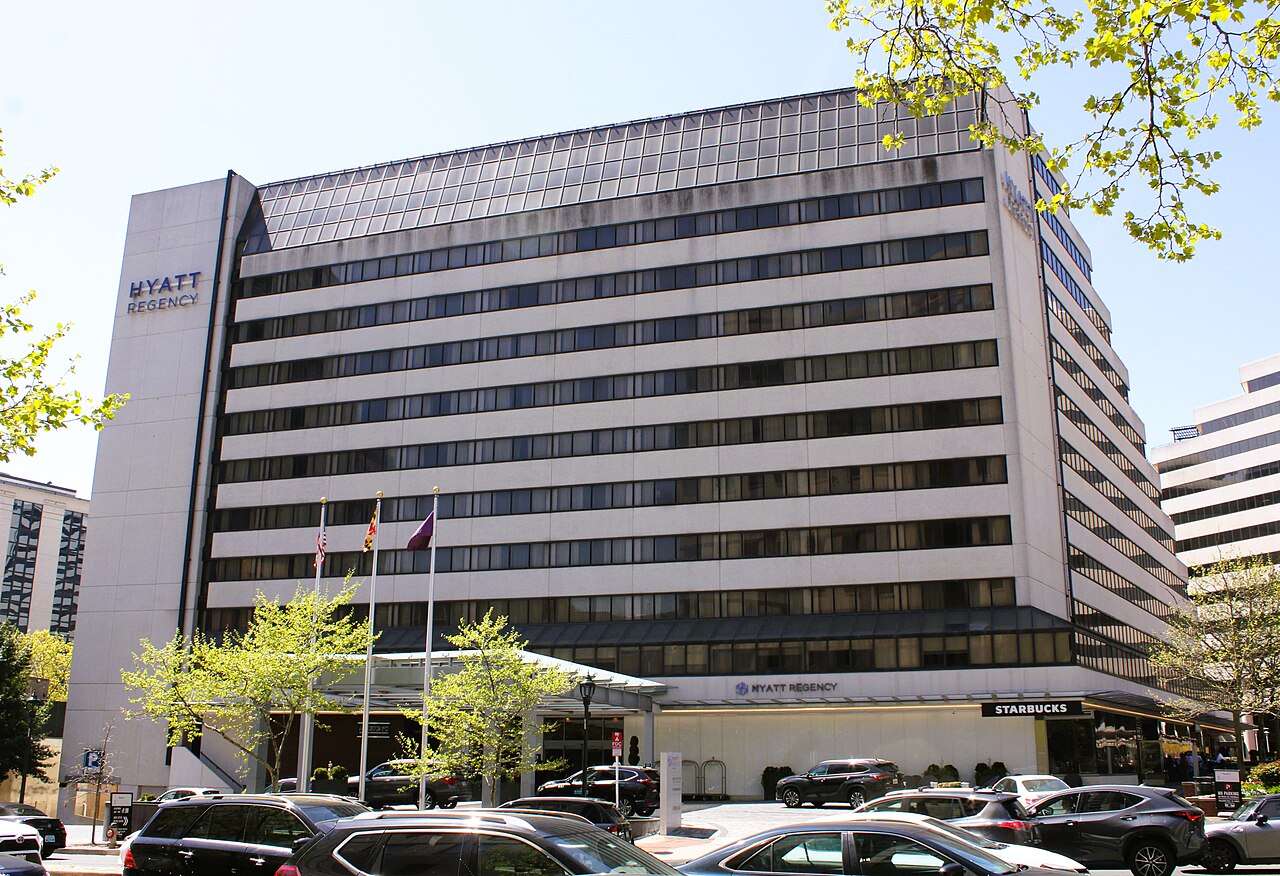
Downtown Bethesda and the Hyatt Regency
Geographic context photograph — not a crime-scene image.
Read the evidence notes
Downtown Bethesda and the Hyatt Regency. Geographic context only; this hotel is not identified as part of the crime.
Commons-provided image; no content edits. The source and reuse terms are linked below.
Farragutful · Image source · CC BY-SA 4.0
Old Georgetown Road in Bethesda
Geographic context photograph — not a crime-scene image.
Read the evidence notes
Old Georgetown Road in Bethesda. A later streetscape, not the Lululemon storefront or a reconstructed route.
Commons-provided image; no content edits. The source and reuse terms are linked below.
Farragutful · Image source · CC BY-SA 4.0
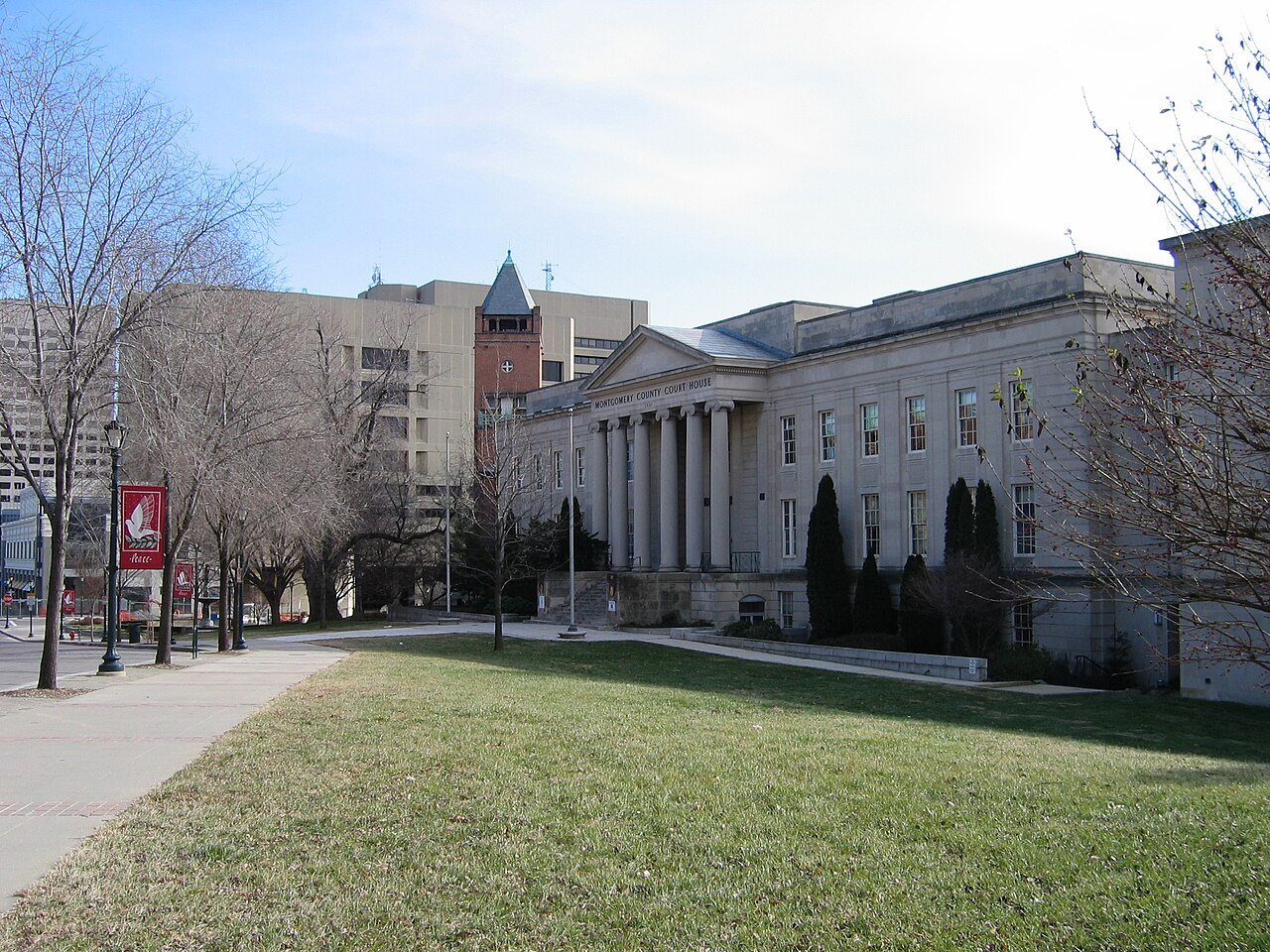
Montgomery County courthouse buildings in Rockville, photographed in 2006
Geographic context photograph — not a crime-scene image.
Read the evidence notes
Montgomery County courthouse buildings in Rockville, photographed in 2006. Judicial setting; the photograph does not identify Norwood’s courtroom.
Commons-provided image; no content edits. The source and reuse terms are linked below.
Aude · Image source · CC BY-SA 2.5
★ Key evidence used in a conviction · ✓ Exclusion or reversal · ◇ Disputed evidence · ⊘ Excluded at retrial · ◆ Identity / investigative finding, not a conviction. A symbol does not mean one item proved the whole case.
Follow the locations
Put the story on the map.
Follow the dated entries, then select an event to find its regional setting. Shared-location pins open a group of events. Evidence symbols identify important findings and their limitations.
Open the map in its own window ↗Sources & further reading
- Norwood v. State — Maryland Court of Special AppealsReturn to shop, staging, interviews, trial issues, verdict, sentence and appeal. Government judicial opinion; court facts read with appellate posture.
- In Memoriam: Jayna Murray — George Washington University2003 graduation, field of study and further education. Biography paraphrase under 100 words.
- State v. Norwood — Montgomery County State’s Attorney sentencing coverageOfficial collection of contemporary sentencing reports; linked reporting is not substituted for the court opinion.
Editorial review: 2026-10-06 · 1696 words