Tynesha Stewart went home to Houston for spring break in March 2007. She had plans to see friends, go to a concert and take a trip. She left a friend’s apartment early one morning expecting to return. After she disappeared, police interviewed the man who picked her up and examined his apartment. At his trial a jury heard the circumstances of the disappearance and forensic findings from the search. It returned a guilty verdict before hearing Timothy Shepherd admit the killing in the punishment phase. [1] [2]
Case brief
Houston and College Station, Texas · 2007
- Recorded outcome
- Timothy Shepherd convicted of murder and sentenced to 99 years. The direct appeal failed in 2011. Federal habeas relief was denied in 2018.
Key moments
People in this case
- Tynesha Stewart
Murder victim
Photo at source · The Charley Project · case photographs - Timothy Shepherd
Convicted of Tynesha Stewart’s murder
Photo at source · The Charley Project · labeled photograph
Stu Seeger · Image source · CC BY 2.0

A student home for spring break
Tynesha had started at Texas A&M University in 2006. She had been dating Shepherd and had lived with him before going to college. Witnesses described frequent calls from him during her first semester and concern on her part that he would follow her when she came home. In March 2007 she made plans with friends during a break from school. Her schedule gave them a reason to notice quickly when she failed to return or appear where they expected her. [1]
Early on March 15 Shepherd picked Tynesha up from a friend’s apartment. She left her phone behind and told her friend she would be back. Her sister spoke with her later that day and learned she was with Shepherd, according to the appellate record. A neighbor recalled seeing her go up the stairs to Shepherd’s apartment. These observations independently placed her with him or at the building. They did not show what happened once she was inside. [1]
Tynesha missed the concert and did not return to collect the phone. When her friend contacted her family, police began looking for her. Shepherd told a deputy she had been to his apartment, that they had argued and that she left on foot. That account explained the prior observations up to a point. It gave police an event to try to corroborate: an actual departure from the property followed by movement through Houston that might have put her in contact with other people. [1]
An ordinary emergency call becomes relevant
The neighbor described unusual activity on Shepherd’s patio within a day or so of seeing Tynesha. Firefighters and a deputy responded when a fire on the patio drew concern. They made observations inside the apartment, but the deputy did not identify evidence of a crime on that visit. Their observations became part of the later case because they could describe conditions close to the time of the disappearance. The fact that they were there did not give them the ability to identify every material they saw. [1]
At trial the neighbor could also describe what was routine before that weekend. He had lent Shepherd a grill and knew how the two ordinarily shared food. He remembered an extended period of use and a change in that ordinary behavior. The unusual pattern did not establish by itself what had happened. It acquired evidentiary weight when investigators compared the time of the fire, the last sighting and what the searches turned up. The firefighters and deputy were separate witnesses who could testify about their own visit without having witnessed the earlier activity. [1]
On March 19 a deputy visited Shepherd with Tynesha’s mother and friend. Shepherd consented to a look around. The deputy noticed fresh paint. A further consent search after questioning the next day produced presumptive indications of blood in several bathroom locations. Presumptive tests can guide collection and further testing. They do not identify whose blood a substance is or establish a complete account of how it got there. [1]
A search led by information, then a warrant
A community activist known as Quanell X met Shepherd while helping the family search. With a sheriff’s sergeant accompanying them, Shepherd directed the group to a dumpster at another apartment complex and indicated it was a place where he had put Tynesha. Authorities arrested him. A search of the dumpster did not recover her remains. The opinion describes a decision against a later search of the landfill to which the contents had been taken. The location Shepherd indicated and the outcome of the search have separate meanings. His statement gave police a place to look. It did not result in a recovery there. [1]
After the arrest Shepherd gave police a statement. Detectives obtained a warrant and searched again, taking items including drains and a garbage disposal. His police confession was not introduced in the guilt phase. That is a significant boundary in reconstructing what the jurors knew. An investigative statement can help police decide what to search for and still be absent from the evidence on which jurors are asked to decide guilt. [1]
The encounter with the activist also complicated the question of who represented whom. The appellate account describes Shepherd speaking with an attorney who also represented Quanell X, and a prosecutor raising a possible conflict. Shepherd briefly met with the attorney after the arrest and then gave a statement. This procedural history is relevant to the sequence that preceded the warrant. It should not be written as if the conflict concern or the resulting statement was the evidence on which the jury returned the murder verdict. [1] [2]

Astronautilus · Image source · CC BY 2.0

What the samples could establish
An analyst testified about a blood mixture on jeans and material recovered from the disposal. In the reported tests Tynesha could not be excluded as a possible contributor to some of the material. The phrase describes inclusion in a range of possible contributors. It does not identify someone with the specificity of a complete match. The state could argue the results supported its account in light of the surrounding evidence. The tests did not supply a uniquely identified body recovered from a disposal site. [1]
A forensic anthropologist examined fragments collected below the patio. Her testimony concerned the shape and condition of fragments and marks on them. She saw features consistent with human bone, but could not say to a reasonable scientific certainty that the fragments were human. That uncertainty went before the jury. It limits the claim that can be made about the fragments even though the court allowed the testimony and later affirmed. [1]
Those two examinations addressed different questions. One asked whether genetic material could have come from a particular person. The other examined physical characteristics and changes in a fragment. Jurors could consider both with the testimony about Tynesha’s last known movements and the search. No single finding did all the work of establishing an identity, a cause of death and responsibility. [1]
What jurors heard after the verdict
The jury convicted Shepherd of murder. Only after the finding of guilt, during the punishment phase, did Shepherd testify and admit strangling Tynesha. He also described concealing evidence after the killing. The jury assessed a ninety-nine-year sentence. His account at punishment and his earlier statement to police are separate events. Neither should be written as though it were a confession the jury had before deciding the guilt question. [1] [2]
The order matters for understanding the strength and limits of the earlier evidence. If a reader starts with the later admission, every trace found in the apartment can appear to have an obvious explanation. Before hearing it, the jury had to decide how the traces fit with Tynesha’s disappearance, the timing of events and testimony about Shepherd’s conduct. The verdict came before the admission in court. [1]
i_am_jim · Image source · CC BY-SA 3.0

The appellate record
The Texas Fourteenth Court of Appeals affirmed in January 2011. Its opinion addressed the handling of the search warrant record, a requested self-defense instruction, and challenges to expert testimony, among other issues. On the forensic issue the court examined whether the anthropologist was qualified and whether her methods and opinions could help the jury. The trial testimony included her limitations. The affirmance did not replace the limits with a firmer laboratory result. A later federal order dismissed Shepherd’s habeas petition and declined to issue a certificate of appealability. [1] [2]
The warrant question was also a record question. During the direct appeal, the court paused proceedings to allow the trial court to determine what had happened to the warrant and affidavit in the earlier suppression hearing. A supplemental record showed that the materials had been considered for that limited purpose. That made it possible for the appellate judges to assess the claim on the record rather than assuming the document had never been before the judge. Admission for a hearing is different from admission as evidence to the jury. [1]
On the requested self-defense instruction, the appellate court considered the evidence available during the guilt phase. Statements made later at punishment could not supply the basis for an instruction that would have preceded the verdict. The judges considered whether the earlier record supported the instruction Shepherd wanted. Their analysis offers another reason to preserve the order in which evidence reached the jury, rather than placing the later admission in a single undifferentiated trial narrative. [1]
The chronology begins in College Station and follows Tynesha’s return to Houston, the efforts to find her, the searches and the two phases of trial. Her spring-break plans explained why people were looking for her and what ordinary activity had stopped. The later admission answered a question that her friends and family had been asking since she missed the things she had arranged to do. [1]
Look closer · 9 visuals
Inside the evidence.
Open a visual to explore what it contributed to the case—and the limits of what it shows. Photographs, historical reproductions and original illustrations are individually labeled. Open the notes for each image’s source, credit, and limitations; setting photographs do not depict crime scenes.
The last known contacts
Original editorial illustration — not an actual evidence photograph or exhibit.
Read the evidence notes
Independent observations placed Tynesha with Shepherd or at his building.
They do not record what occurred inside.
The searches developed in stages
Original editorial illustration — not an actual evidence photograph or exhibit.
Read the evidence notes
Police had distinct bases for different searches.
Presumptive findings do not establish identity.
What the mixtures showed
Original editorial illustration — not an actual evidence photograph or exhibit.
Read the evidence notes
Testing did not exclude Tynesha from some samples.
Possible inclusion is less specific than a unique identification.
Fragment analysis
Original editorial illustration — not an actual evidence photograph or exhibit.
Read the evidence notes
The expert explained similarities and uncertainty.
The analysis did not identify the fragments to Tynesha.
A search without recovery
Original editorial illustration — not an actual evidence photograph or exhibit.
Read the evidence notes
Police checked the place Shepherd identified.
A lead is distinct from a physical recovery.
The order the jury heard it
Original editorial illustration — not an actual evidence photograph or exhibit.
Read the evidence notes
Shepherd testified after the guilty verdict.
The earlier police confession was not introduced in the guilt phase.
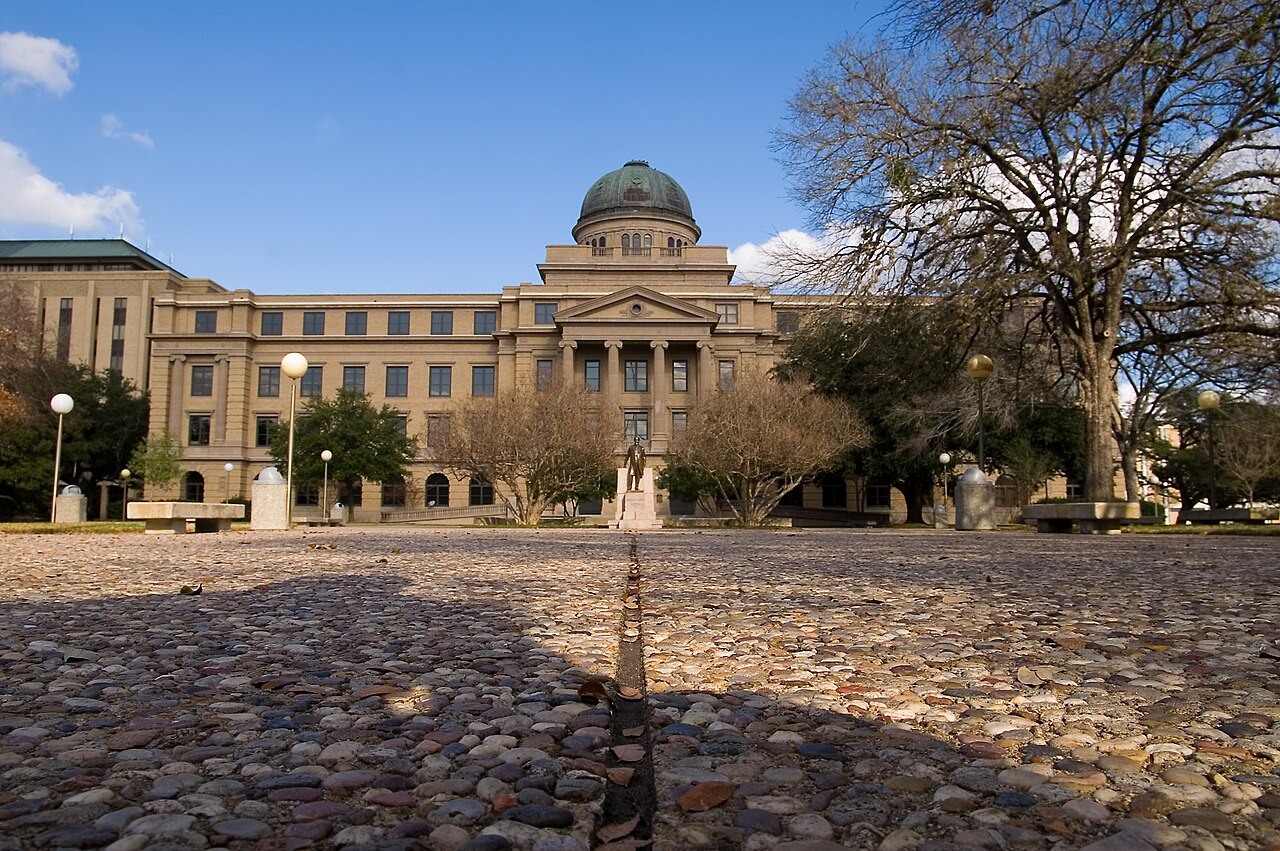
The Academic Building at Texas A&M University in College Station
Setting photograph for geographic context.
Read the evidence notes
The Academic Building at Texas A&M University in College Station. The image does not depict the crime or an evidence exhibit.
The image does not depict the crime or an evidence exhibit. The source and reuse terms are linked below.
Stu Seeger · Image source · CC BY 2.0
Downtown Houston and Buffalo Bayou
Setting photograph for geographic context.
Read the evidence notes
Downtown Houston and Buffalo Bayou. The image does not depict the crime or an evidence exhibit.
The image does not depict the crime or an evidence exhibit. The source and reuse terms are linked below.
Astronautilus · Image source · CC BY 2.0
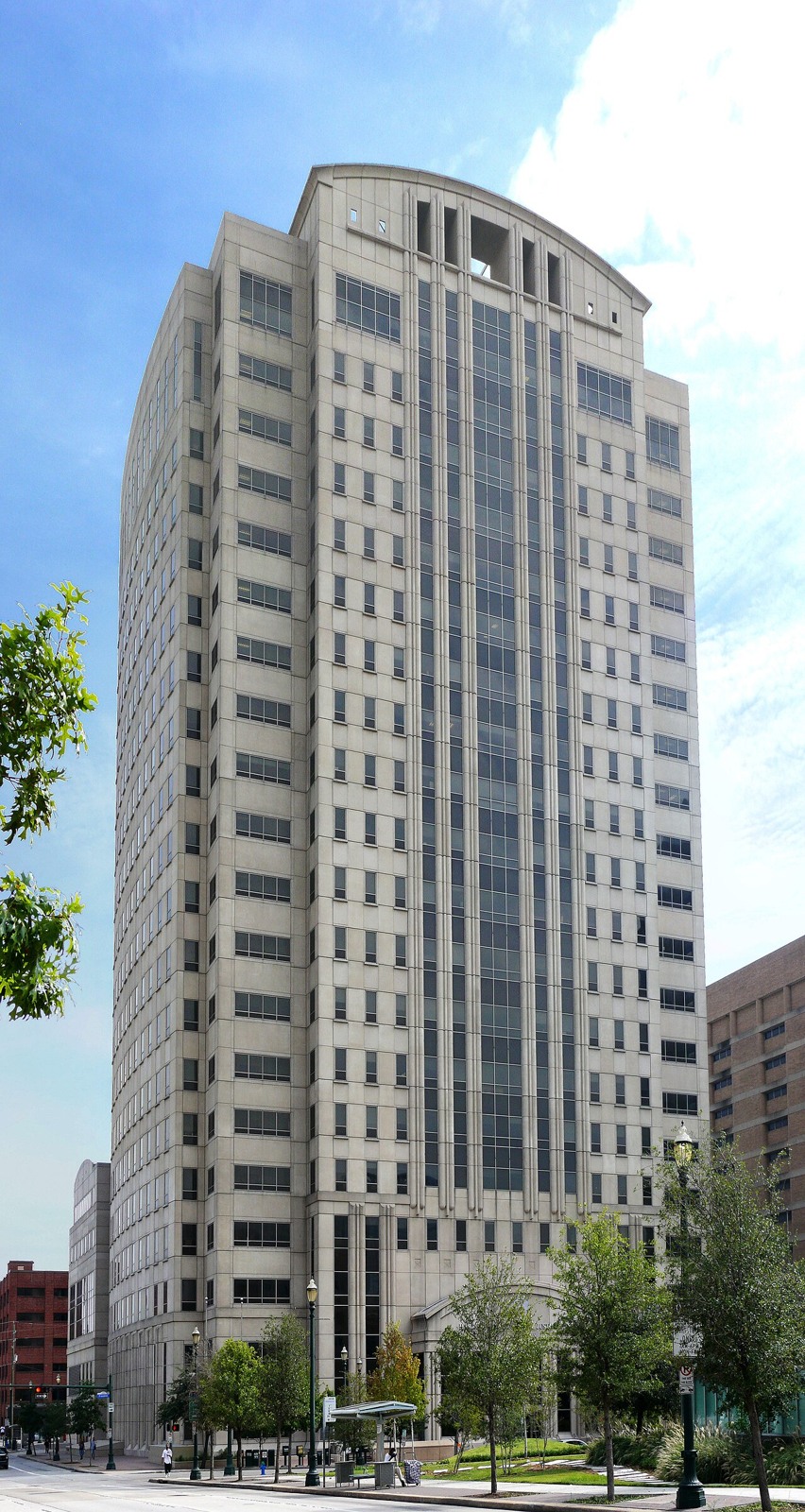
Harris County Criminal Justice Center in Houston
Setting photograph for geographic context.
Read the evidence notes
Harris County Criminal Justice Center in Houston. The image does not depict the crime or an evidence exhibit.
The image does not depict the crime or an evidence exhibit. The source and reuse terms are linked below.
i_am_jim · Image source · CC BY-SA 3.0
★ Key evidence used in a conviction · ✓ Exclusion or reversal · ◇ Disputed evidence · ⊘ Excluded at retrial · ◆ Identity / investigative finding, not a conviction. A symbol does not mean one item proved the whole case.
Follow the locations
Put the story on the map.
Follow the dated entries, then select an event to find its regional setting. Shared-location pins open a group of events. Evidence symbols identify important findings and their limitations.
Open the map in its own window ↗Sources & further reading
- Shepherd v. State · Texas Fourteenth Court of AppealsDisappearance, searches, forensic limitations, phase of admission and affirmance.
- Shepherd v. Davis · U.S. District Court habeas orderFederal review, procedural history and dismissal.
Editorial review: 2026-11-09 · 1539 words