The first alarm came while doctors were trying to explain Linda Curry’s illness. A nurse found the fluid in an IV bag unusually cloudy. Months later, during another admission, a nurse found damage in the IV line. Those incidents remained in the record when Linda died at home in 1994. The final toxicology finding involved nicotine, a different substance from the one detected in the first hospital incident. Connecting the hospital events, Linda’s death and the insurance policies would take years. [1] [2]
Case brief
San Clemente and Orange County, California · 1994
- Recorded outcome
- Paul Curry convicted of murder for financial gain, sentenced to life without parole in 2014 and affirmed on appeal.
Key moments
People in this case
- Linda Curry
Murder victim
Photo at source · CBS News · photograph credited to Bruce Brandt - Paul Curry
Convicted of Linda Curry’s murder
Photo at source · CBS News · Orange County District Attorney’s arrest photograph

Don Ramey Logan · Image source · CC BY-SA 4.0

An illness without an explanation
Linda and Paul Curry married in 1992. She experienced recurring gastrointestinal illness in the months that followed. A July 1993 hospital admission produced no clear explanation for the symptoms. A nurse did, however, notice a change to an IV bag after Paul had left Linda’s room. An examination showed punctures and detected lidocaine, which had not been prescribed to her at that time. The sequence prompted an investigation. There was no eyewitness in the reviewed record to someone putting anything into the bag. [1]
The bag was valuable evidence because staff could describe an abnormality in equipment under their care. The timing of a visitor’s departure supplied a separate observation. The lab finding was specific to the material tested. Inferences about a person’s conduct depended on combining those observations with the rest of the record. It would have been too quick to use a hospital alarm as a record of who tampered with the equipment. [1]
Linda spoke with police after the first incident. The interview was recorded. She discussed financial concerns and the possibility that Paul might have a motive to harm her, while also expressing uncertainty. Years later the recording captured what she had told police before her death. That made it relevant to the sequence and to the investigators’ later questioning. It also made the permitted use of her statements an issue for the court. A recording proves that someone said something. It does not necessarily prove every assertion or suspicion in the recording. [1]
A second alarm and a different finding
Linda was hospitalized again late in 1993. After a visit from Paul, a nurse responded to an alarm and found fluid spilling from the line and a connection damaged. The appellate court describes apparent tampering. The second incident reinforced concerns raised by the first. It did not supply a second finding of lidocaine or establish that the same mechanism was used both times. Linda later told her sister Patricia that she did not want Paul near her at the hospital if she fell ill again. [1]
That request was an action Linda could take after a frightening experience. It gave prosecutors a reason to examine her understanding of what had happened and to compare it with statements Paul made about the marriage. It also raised a problem for jurors. A person can be justified in taking a precaution without possessing conclusive evidence about the cause of an illness. The state needed to establish the fatal cause and the person responsible through evidence beyond the caution Linda had expressed. [1]
June 1994 and the toxicology
On June 9, 1994, Paul called emergency services to report that Linda was unconscious. Responders tried to revive her, and she was pronounced dead at the hospital early the following morning in the appellate account. The medical examiner attributed her death to acute nicotine poisoning. Toxicology also showed elevated levels of a sedative. Linda was a nonsmoker. The prosecution used those findings together with the evidence that Paul had been alone with her during the relevant evening. [1] [2]
The state argued that a mark behind Linda’s ear was consistent with administration by injection after she had been sedated. Defense experts disputed both the interpretation of the mark and aspects of the toxicology analysis. The medical finding of a fatal poisoning was a different proposition from the state’s theory about the exact route of administration. The jury did not have a witness who saw an injection. It was asked to draw conclusions about the fatal event from the medical evidence, the timing, the financial record and the prior incidents. [1]
Prosecutors could point to a short interval between exposure and death in the medical examiner’s opinion. That narrowed the period in which someone would have had an opportunity. Defense counsel could question the certainty of that reconstruction and offer alternative explanations for how Linda encountered the substance. The existence of those alternatives in argument should not be confused with a medical finding supporting them. The testimony had to be assessed against the actual measurements and circumstances. [1]

Charles O'Rear · Image source · Public domain


The policies that survived Linda
Paul collected substantial insurance proceeds after Linda’s death. He learned that she had changed beneficiaries on some policies so Patricia would receive them. The financial records mattered because they could establish payments and beneficiaries independently of someone’s memory about a conversation. They also allowed prosecutors to compare what Paul told police with what insurers had done. A benefit under a contract is not evidence of guilt by itself. The state used the policies to explain why it believed he stood to gain from a death it had separately characterized as a homicide. [1] [2]
The dispute between Paul and Patricia over proceeds was another event after the death. The appellate opinion describes his efforts to obtain money from the disputed policies. That history helped the state make a case about the significance of the insurance to him. It did not change the science of the poisoning, and a person’s reaction to learning about a beneficiary designation cannot by itself show what happened in the house. The financial and forensic records were important precisely because they could be compared without treating them as the same kind of evidence. [1]
Why the charge took sixteen years
Paul was interviewed in 1994 and denied wrongdoing. Investigators did not charge him then. He moved to Kansas and remarried. In November 2010 he was arrested, and an investigator played him portions of Linda’s recorded interview. The prosecution and defense would dispute how his answers could be used and how the years between the death and the charge affected his ability to contest the case. [1] [2]
The Orange County district attorney dates the renewed investigation to 2007. That gives the case an intermediate milestone between the initial inquiry and the Kansas arrest. Investigators had to compare the original medical material, records of money and the descriptions of the relationship with information still available. The passage of time made it harder for either side to obtain a complete account. A later charge is evidence that prosecutors decided to proceed, rather than evidence that every missing record had been recovered. [1] [2]
Some evidence was unavailable by trial. The defense described loss of medical and prescription records, questions about how samples had been retained and the loss or fading memories of responders. The appellate court considered whether those gaps created actual prejudice under the due process standard it applied. It held that the claimed harm was too speculative or did not establish how the missing material would have helped on a disputed issue. That ruling left the prosecution free to proceed without requiring a finding that every decision made during the delay had been ideal. [1]
A separate pretrial ruling examined whether Linda’s hospital statements to police were testimonial and could be admitted under the rules governing confrontation and forfeiture. The court distinguished the fact of a murder charge from proof that a defendant acted with the purpose of making a witness unavailable. Later proceedings considered other uses of statements, including parts of Paul’s own interview and responses. Those rulings should not be compressed into a claim that jurors could treat everything Linda had said to anyone as established fact. [1] [3]
One reason the response mattered was that the questioning in 2010 juxtaposed two accounts recorded years apart. An investigator could put a specific allegation to Paul and ask him to respond. For the jury, the questions were what he accepted, what he denied and whether his answers contradicted documents or earlier statements. His hearing Linda’s words on a tape did not automatically amount to accepting all of them. The appeal examined the uses of those exchanges within the broader evidentiary record. [1]
Nkpug · Image source · CC BY-SA 4.0

The verdict and the appeal
In 2014 jurors found Paul guilty of murder with the special circumstance of financial gain. He was sentenced to life without parole. The case on appeal challenged the delay, admission of statements and the instruction concerning the need for evidence independent of an out-of-court statement to establish a crime. The appellate court affirmed. The state’s theory of administration remained a theory supported by circumstantial evidence. The verdict established the murder judgment and special circumstance. [1] [2]
The two IV incidents and the death occupy separate places on the map. Hospital personnel recorded equipment anomalies in 1993. A medical examiner identified fatal nicotine poisoning in 1994. The insurance records helped establish the stakes and test subsequent statements. Keeping those lines separate shows how the state built a case without making the earlier lidocaine finding into the substance that killed Linda. [1] [2] [3]
Look closer · 9 visuals
Inside the evidence.
Open a visual to explore what it contributed to the case—and the limits of what it shows. Photographs, historical reproductions and original illustrations are individually labeled. Open the notes for each image’s source, credit, and limitations; setting photographs do not depict crime scenes.
The two IV incidents
Original editorial illustration — not an actual evidence photograph or exhibit.
Read the evidence notes
Nurses identified separate abnormalities in 1993.
The second incident did not establish the same substance.
What the toxicology established
Original editorial illustration — not an actual evidence photograph or exhibit.
Read the evidence notes
Medical findings supported cause of death.
The proposed injection route remained disputed.
Linda’s recorded interview
Original editorial illustration — not an actual evidence photograph or exhibit.
Read the evidence notes
Linda described concerns after the first hospital incident.
Recorded suspicions cannot substitute for proof.
The beneficiary record
Original editorial illustration — not an actual evidence photograph or exhibit.
Read the evidence notes
The financial record supported the state’s motive theory.
Receipt of benefits by itself does not establish guilt.
A long interval before charges
Original editorial illustration — not an actual evidence photograph or exhibit.
Read the evidence notes
The agencies reopened the inquiry years later.
The timing of charges and the date of death are separate.
What the appeal reviewed
Original editorial illustration — not an actual evidence photograph or exhibit.
Read the evidence notes
The judges reviewed challenges to the trial judgment.
They did not make an independent finding of the exact dosing mechanism.
San Clemente Pier and the coastline
Setting photograph for geographic context.
Read the evidence notes
San Clemente Pier and the coastline. The image does not depict the crime or an evidence exhibit.
The image does not depict the crime or an evidence exhibit. The source and reuse terms are linked below.
Don Ramey Logan · Image source · CC BY-SA 4.0
An archival aerial photograph of the San Clemente coastline
Setting photograph for geographic context.
Read the evidence notes
An archival aerial photograph of the San Clemente coastline. The image does not depict the crime or an evidence exhibit.
The image does not depict the crime or an evidence exhibit. The source and reuse terms are linked below.
Charles O'Rear · Image source · Public domain
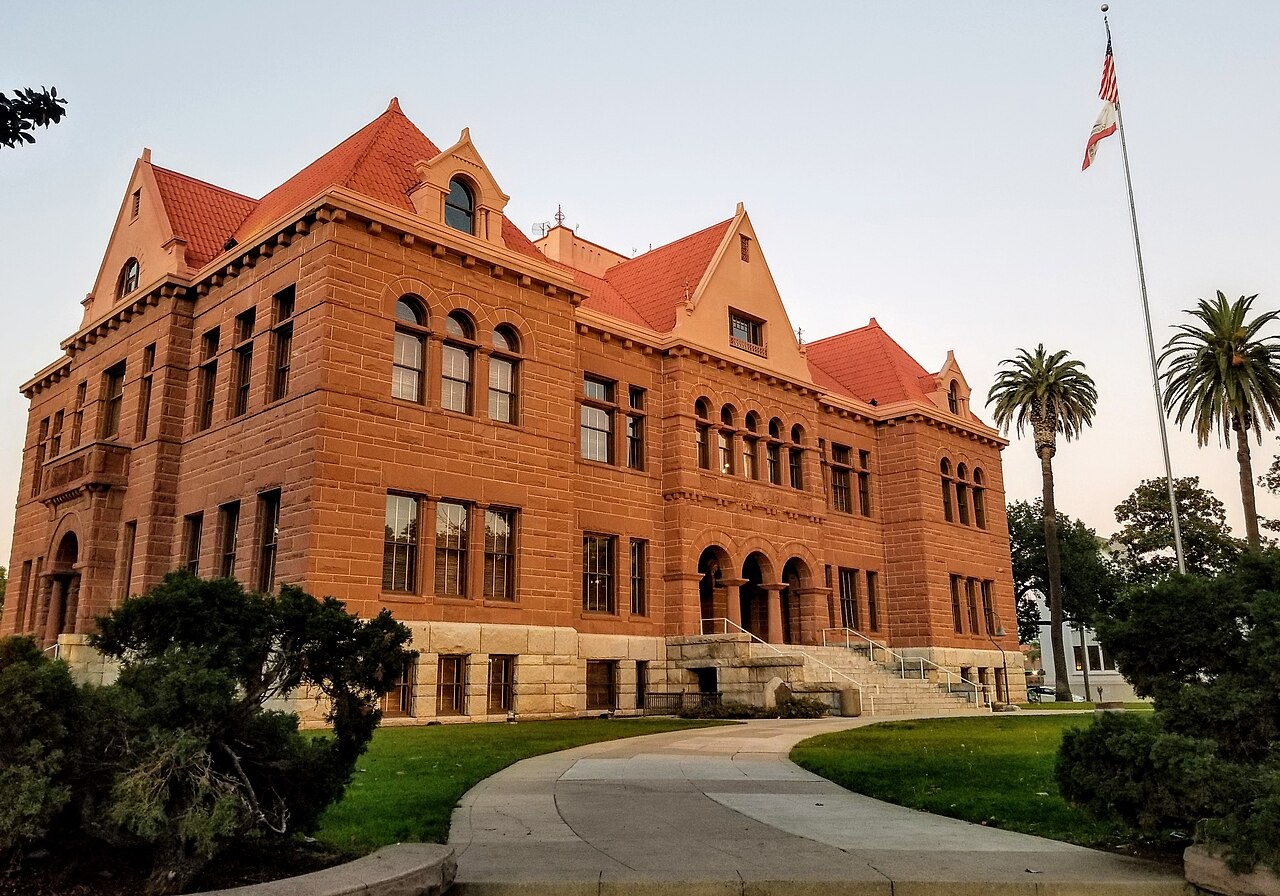
The historic Orange County Courthouse in Santa Ana
Setting photograph for geographic context.
Read the evidence notes
The historic Orange County Courthouse in Santa Ana. The image does not depict the crime or an evidence exhibit.
The image does not depict the crime or an evidence exhibit. The source and reuse terms are linked below.
Nkpug · Image source · CC BY-SA 4.0
★ Key evidence used in a conviction · ✓ Exclusion or reversal · ◇ Disputed evidence · ⊘ Excluded at retrial · ◆ Identity / investigative finding, not a conviction. A symbol does not mean one item proved the whole case.
Follow the locations
Put the story on the map.
Follow the dated entries, then select an event to find its regional setting. Shared-location pins open a group of events. Evidence symbols identify important findings and their limitations.
Open the map in its own window ↗Sources & further reading
- People v. Curry · California Court of AppealTrial facts, toxicology, delay and statement rulings.
- Orange County District Attorney · verdict and sentence2007 reinvestigation, Kansas arrest, verdict and sentencing.
- Curry v. Superior Court · pretrial writConfrontation and forfeiture issues involving Linda’s statements to police.
Editorial review: 2026-11-09 · 1506 words