On May 20, 2012, a mounted dinosaur skeleton drew a winning bid of more than a million dollars in Manhattan. The bid was conditional. Mongolia had already objected, and a legal challenge meant a price on the auction floor did not settle who owned the bones. Federal investigators examined a record that looked different from the mounted animal in the auction catalog. It included shipments of separated material, declarations about what the shipments contained and a question of whether any lawful export from Mongolia had occurred. [1] [2] [4]
Case brief
Manhattan and Mongolia, New York · 2012
- Recorded outcome
- Eric Prokopi pleaded guilty to three federal offenses in 2012. The auction skeleton was handed over in 2013, and he was sentenced in 2014.
Key moments
Case photographs
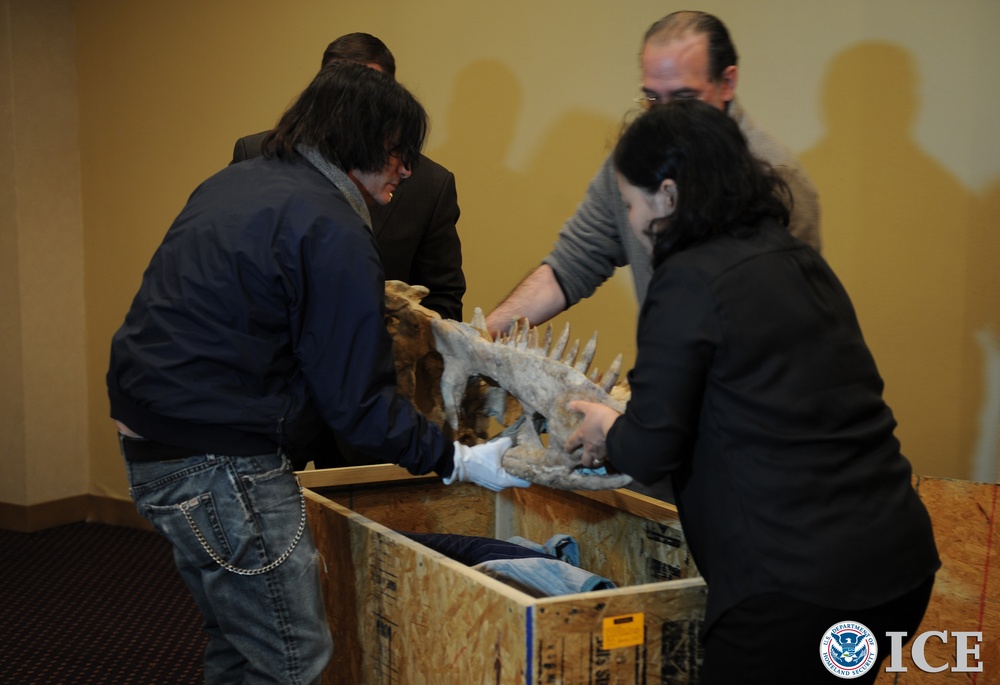
The Tarbosaurus skull above its crate The skull from the seized skeleton is handled above a wooden crate during the May 2013 repatriation to Mongolia.
Repatriation photograph · Michael Johnson, U.S. Immigration and Customs Enforcement · U.S. public domainThe appearance of U.S. Department of War (DoW) visual information does not imply or constitute DoW endorsement.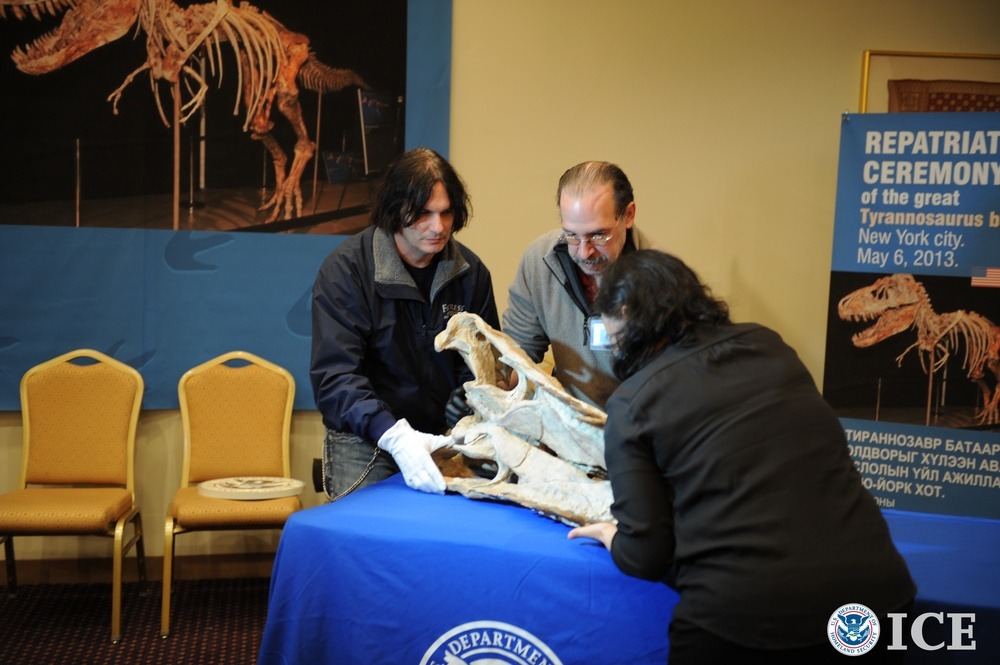
Tarbosaurus fossil repatriation Officials handle fossil material at the 2013 handover to Mongolia.
Repatriation photograph · Michael Johnson, U.S. Immigration and Customs Enforcement · U.S. public domain
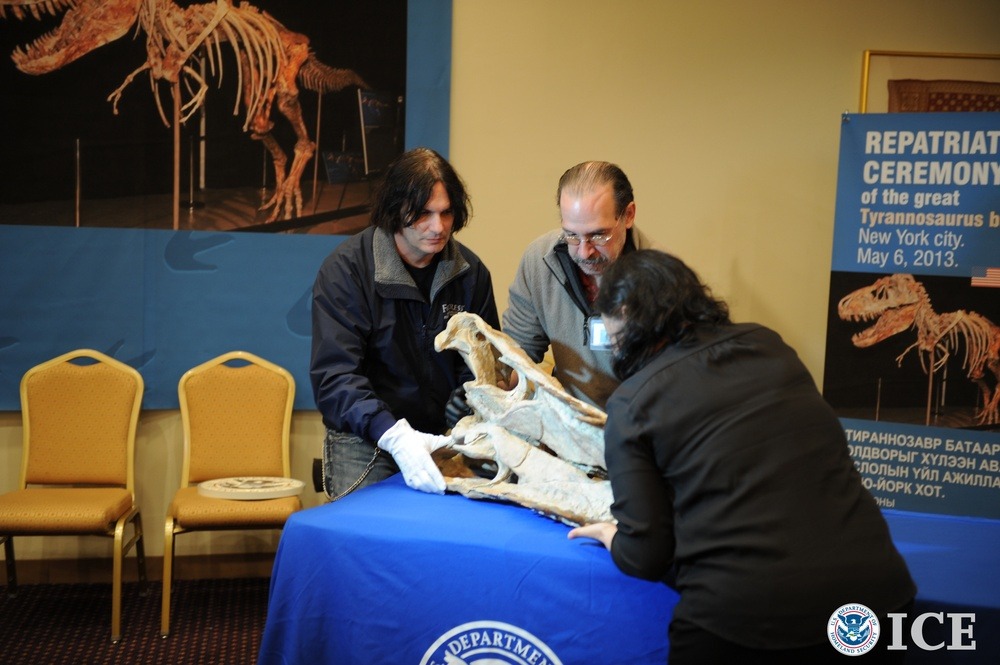
Michael Johnson / U.S. Immigration and Customs Enforcement · Image source · Public domain · The photo documents the handover, years after the fossil was unearthed.
An animal whose name traveled with the case
The government’s papers called the animal Tyrannosaurus bataar. It is also known as Tarbosaurus bataar, the name used in the identification of the species described by paleontologist Evgeny Maleev. It was a large carnivorous dinosaur from Asia. The nomenclature in a court caption can make it sound like a specimen of the North American Tyrannosaurus rex. It is a different animal. The auctioned object was a nearly complete mounted skeleton, not a live animal or a single fossil tooth. [1] [2] [4]
The species’ known geographic distribution mattered because a claim about the shipment’s origin could be checked against the identity of the bones. It did not give officials a set of coordinates for a dig. Paleontologists could look at features of the skeleton and its characteristics and assess the likely source. Export documents and the movement of the shipment were separate evidence. The case depended on connecting the scientific identification with a legal history and a trail of importation. [1] [4]
An object assembled after shipment
Eric Prokopi was a Florida fossil dealer. The federal complaint describes a shipment from Great Britain to the United States in 2010 that contained fossil material later associated with the auctioned skeleton. The allegations concerned the accuracy of declarations about the kind of objects, their value and their country of origin. A box can leave one country even when the fossil inside originated in another. That ordinary feature of international shipping mattered once the government investigated whether the records accurately reflected the bones’ provenance. [1] [2]
The physical object changed form along the way. Separately packed bones could be worked on, fitted together and displayed as a recognizable dinosaur. A declared value for material crossing a border and a later bid for a mounted skeleton are not inherently comparable dollar for dollar. Preparation can add labor and market value. The case involved the government’s allegations of false declarations and unlawful origin, in addition to the striking difference between what was said to be in a shipment and what stood in front of bidders in New York. [1] [2]
ICE identified March 27, 2010, as the import date for the shipment. The declared value was $15,000. The papers described mixed fossil reptile material and gave Britain as the origin. Those were claims an investigator could compare with what experts later saw. The country entry drew attention because British export of a crate would not tell an official where the animal lived or where the fossil was excavated. The valuation drew attention because it was one of several discrepancies, rather than because the auction price alone could establish fraud. [1] [4]
For a curator, an object’s excavation context can include information that an attractive mount cannot recover. Provenance for ownership asks who had the right to possess or transfer it. Scientific provenance asks where and in what context it was found. An auction listing may offer a persuasive identification while leaving one or both chains incomplete. The later investigation shows how experts and investigators approached those questions independently of the price the seller hoped to receive. [1] [4]
A high bid and a disputed sale
The auction made the fossil visible. Mongolia’s government raised the issue before the auction and objected to the sale. The high bid was made subject to the outcome of the dispute. Federal releases use language that sometimes calls the skeleton sold at auction, but the conditional bid does not demonstrate that the bidder obtained title or took possession. The central dispute was already whether the item could lawfully be sold at all. [1] [2] [4]
Mongolia’s position rested on its legal claim to fossils of this kind. American officials described a Mongolian prohibition dating to 1924 on private ownership and export of culturally significant objects including dinosaur remains. What mattered to the American proceedings was how that ownership claim and the facts of export and import supported forfeiture and criminal charges. It was not enough to identify a dinosaur from Mongolia and assume every object of that species sold anywhere followed the same route. The government built its case around particular material and declarations. [1] [4]
On June 5, experts examined the skeleton at Mongolia’s request. They identified it as a Bataar and attributed it to the western Gobi Desert. ICE later pointed to the bones’ coloration as one of the features experts used when giving an opinion about provenance. That physical assessment mattered because the customs documents purported to give an origin. The scientists were testing the statement about the thing itself. The lawyers still had to address its export and the effect of Mongolia’s ownership claim. In September an amended forfeiture complaint included the paleontological reports. [1] [4]
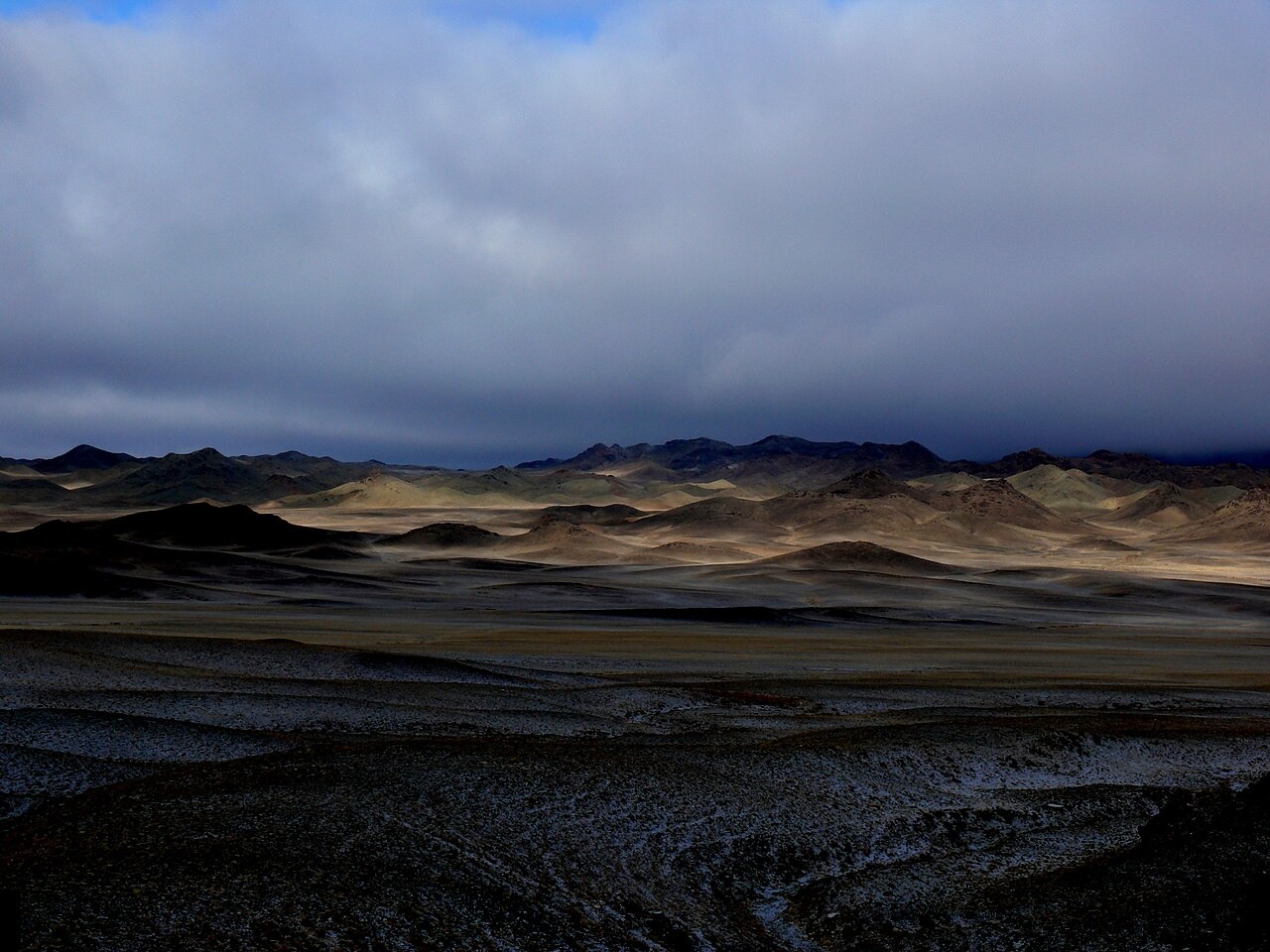
Ksuryawanshi · Image source · CC BY-SA 4.0 · Geographic context; not authentic crime evidence. The building or landscape is public geographic context; no event is assigned to it.

The government brings a case against the skeleton
On June 18, 2012, federal prosecutors filed a civil forfeiture action and obtained authority to seize the skeleton. The unusual caption named the skeleton as the property at issue. A civil case over whether an object may be forfeited asks a different question from a criminal case over whether a person committed an offense. The object could be held while ownership and import issues were litigated. The seizure did not, by itself, enter a judgment of guilt against the dealer. [1] [4] [5]
The government’s complaint set out the shipment history, the auction and evidence developed about the specimen’s origin. The complaint is evidence of what authorities alleged and why they sought the legal action. Later filings and Prokopi’s plea supply a different level of confirmation for the charges he admitted and the forfeiture to which he agreed. Treating the complaint as a list of final findings would erase the very distinction between the two proceedings. [1] [2] [5]
The civil dispute also illustrates what was at stake for people who had no part in any alleged shipment. The government of Mongolia sought return of a specimen it claimed belonged to the country. A bidder could offer a substantial price without receiving a right superior to the rightful owner’s. The government needed authority to take custody and a legal outcome that allowed it to transfer the fossil. Recognition of the species alone could do neither of those things. [4] [5]
The dealer pleads guilty
Prokopi was arrested in October. On December 27 he pleaded guilty in Manhattan federal court. The charging information identified a conspiracy involving a fossil from China, entry of goods through false statements involving the Mongolian dinosaurs and interstate and foreign transportation of goods taken by fraud. He also consented to forfeiture of the auction specimen and other skeletons, including a second nearly complete Bataar. The agreement settled issues that had begun with a single, prominent object and reached additional fossils handled in the same broader inquiry. [1] [2] [4]
The counts and the list of objects should not be confused. A count of conviction is an offense admitted in court. A list of forfeited skeletons describes property affected by agreements and proceedings. An item returned later can have a different history from the mounted skeleton or from the specific shipments cited in the criminal case. The government eventually described fossils from more than eighteen skeletons in a later return announcement. That figure does not mean eighteen identical auction lots or eighteen separate convictions. [2] [3]
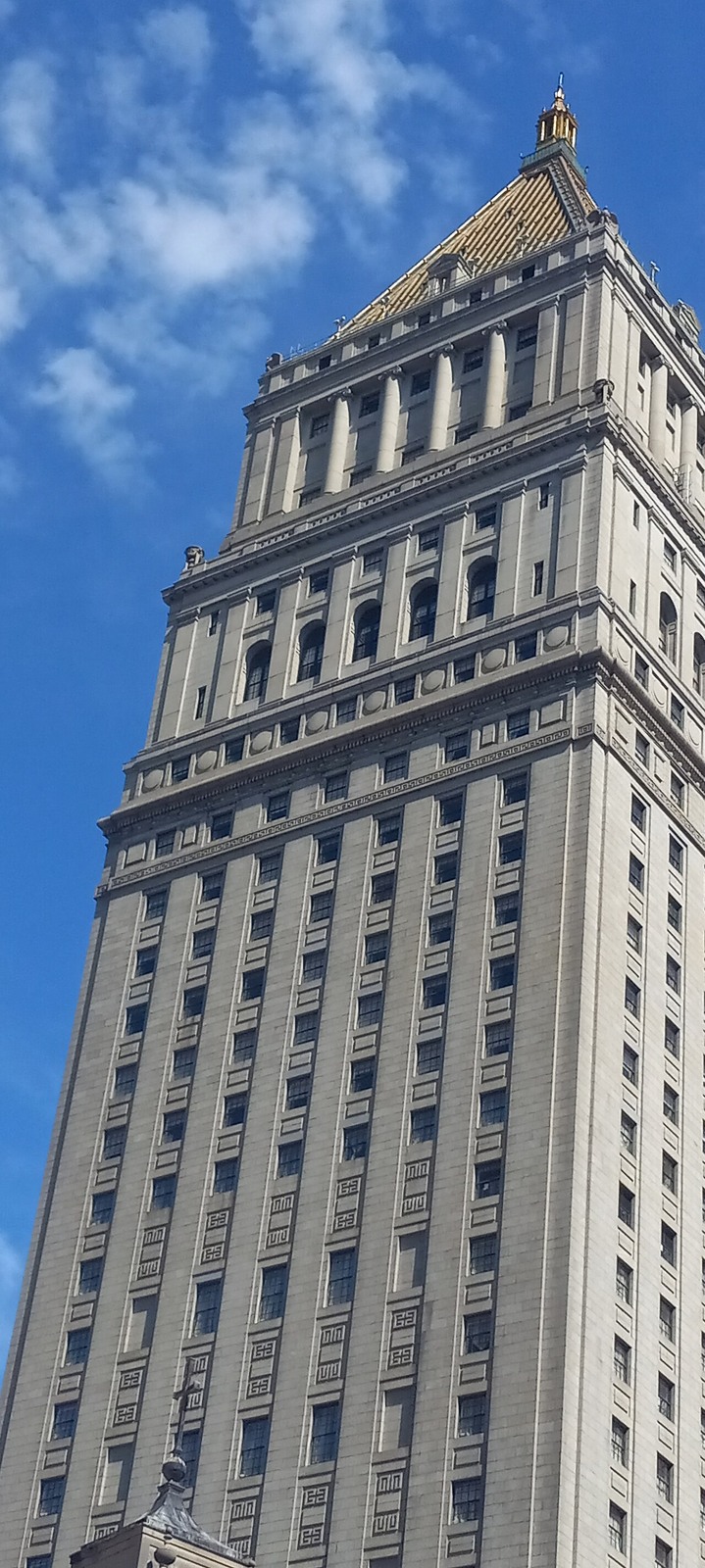
Kidfly182 · Image source · CC BY 4.0 · Geographic context; not authentic crime evidence. The building or landscape is public geographic context; no event is assigned to it.

From custody to return
On May 6, 2013, American officials held a handover in New York for the first skeleton’s return to Mongolia. At the ceremony representatives of both governments were present. The archival photograph in the gallery documents this handover. The South Gobi landscape photograph serves a different purpose. It gives a sense of the region associated with the species without identifying the dig site of the auction skeleton. [3] [4]
Prokopi was sentenced to three months in prison in 2014. The contemporaneous report and a later Justice Department release give conflicting month references, so this chronology uses the year for the sentence. In July 2014 federal officials announced another return involving fossils from more than eighteen skeletons. Some of the material covered by the wider effort followed different paths to forfeiture or voluntary return. Its connection to the original case is the provenance investigation, not a single shipment containing every fossil. [3] [6]
One such path concerned Christopher Moore, a former business associate. The Justice Department said he told officials that he possessed additional specimens and agreed to send them to the United States for return after being advised they had been stolen from Mongolia. The 2014 announcement included material sent by Moore, among it Gallimimus fossils and a restored display incorporating fossil eggs. The return therefore involved decisions about many individual objects, some of which had never been on the Manhattan auction floor. [3]
The auction catalog answered the question a bidder starts with. It said what impressive object was on offer. The provenance investigation asked a question that came earlier in the object’s history. Who could lawfully put it there? The bones, the documents and the legal actions supplied different parts of that answer. The key marks on the map follow those records through the case, while leaving the precise excavation site and undocumented movements out of the picture. [1] [2] [4]
Look closer · 9 visuals
Inside the evidence.
Open a visual to explore what it contributed to the case—and the limits of what it shows. Photographs, historical reproductions and original illustrations are individually labeled. Open the notes for each image’s source, credit, and limitations; setting photographs do not depict crime scenes.
Origin versus departure point
Original editorial illustration — not an actual evidence photograph or exhibit.
Read the evidence notes
The fossil’s origin and the shipment’s departure country are separate facts.
The sources do not locate a precise excavation site.
The mount changed the object’s form
Original editorial illustration — not an actual evidence photograph or exhibit.
Read the evidence notes
The object appeared differently in shipping and at the auction.
A mounted display does not independently prove lawful origin.
A conditional winning bid
Original editorial illustration — not an actual evidence photograph or exhibit.
Read the evidence notes
A bid over one million dollars drew attention to the specimen.
The bid does not establish a completed sale or transfer of title.
Forfeiture and the criminal case
Original editorial illustration — not an actual evidence photograph or exhibit.
Read the evidence notes
The property proceeding was distinct from Prokopi’s prosecution.
The seizure alone did not determine guilt.
The record behind the bones
Original editorial illustration — not an actual evidence photograph or exhibit.
Read the evidence notes
The government compared records with information about the fossil.
Species and origin are not a complete chain of ownership on their own.
Two stages of return
Original editorial illustration — not an actual evidence photograph or exhibit.
Read the evidence notes
The wider return included fossils from many skeletons.
The returned items did not all come from one shipment or auction lot.
Fossil material from the auctioned Tarbosaurus at the 2013 repatriation
Archival photograph of the actual repatriation.
Read the evidence notes
Officials handle fossil material from the auctioned Tarbosaurus at the May 6, 2013 repatriation ceremony in Manhattan. Official ICE photograph by Michael Johnson.
The photo documents the handover, years after the fossil was unearthed. The source and reuse terms are linked below.
Source 4 ↗ · Michael Johnson / U.S. Immigration and Customs Enforcement · Image source · Public domain
A landscape in Mongolia’s South Gobi region
Context photograph — not an actual crime exhibit. The building or landscape is public geographic context; no event is assigned to it.
Read the evidence notes
A landscape in Mongolia’s South Gobi region. Geographic context photograph; not a crime-scene photograph or an original evidence exhibit. The building or landscape is public geographic context; no event is assigned to it.
Geographic context; not authentic crime evidence. The building or landscape is public geographic context; no event is assigned to it. The source and reuse terms are linked below.
Ksuryawanshi · Image source · CC BY-SA 4.0
Thurgood Marshall United States Courthouse in Manhattan
Context photograph — not an actual crime exhibit. The building or landscape is public geographic context; no event is assigned to it.
Read the evidence notes
Thurgood Marshall United States Courthouse in Manhattan. Geographic context photograph; not a crime-scene photograph or an original evidence exhibit. The building or landscape is public geographic context; no event is assigned to it.
Geographic context; not authentic crime evidence. The building or landscape is public geographic context; no event is assigned to it. The source and reuse terms are linked below.
Kidfly182 · Image source · CC BY 4.0
★ Key evidence used in a conviction · ✓ Exclusion or reversal · ◇ Disputed evidence · ⊘ Excluded at retrial · ◆ Identity / investigative finding, not a conviction. A symbol does not mean one item proved the whole case.
Follow the locations
Put the story on the map.
Follow the dated entries, then select an event to find its regional setting. Shared-location pins open a group of events. Evidence symbols identify important findings and their limitations.
Open the map in its own window ↗Sources & further reading
- United States v. Eric Prokopi · Federal criminal complaintCharging allegations, import history, valuation and auction.
- Justice Department · Prokopi plea and forfeiture agreementThree plea counts and the items subject to forfeiture.
- Justice Department · Return of additional fossils to MongoliaAdditional returns, three-month sentence and voluntary cooperation.
- U.S. Immigration and Customs Enforcement · 2013 handoverSpecies name, export history, seizure and formal handover.
- United States v. One Tyrannosaurus Bataar Skeleton · civil forfeiture docketSeparate property proceeding involving the auction skeleton.
- CBS New York · Sentencing reportContemporary three-month sentence report.
Editorial review: 2026-11-09 · 1584 words