A shot from the back seat passed through the front passenger seat and struck Diane McIver. Her husband, Claud “Tex” McIver, was holding the revolver. Dani Jo Carter, Diane’s close friend, was driving the SUV. The basic arrangement was not in dispute. What the shooting meant was: an intentional killing, reckless conduct, criminal negligence or an accident. Those distinctions would eventually change the legal ending of a case that first produced a murder conviction. [1]
Case brief
Atlanta, Georgia · 2016
- Recorded outcome
- 2018 felony-murder and firearm convictions reversed June 2022; witness-influencing conviction affirmed. Tex McIver pleaded guilty to involuntary manslaughter and related offenses January 2024.
Key moments
People in this case
- Diane McIver
Fatally shot in the case
Photo at source · Atlanta Journal-Constitution · labeled family photographs
In 2018, a jury acquitted Tex of malice murder but convicted him of felony murder and other offenses. In 2022, Georgia’s Supreme Court reversed the homicide judgment because jurors had not received a requested instruction on a lesser grade of involuntary manslaughter supported by some evidence. In January 2024, he pleaded guilty to involuntary manslaughter and related charges. Diane’s death did not change; the legally sustained description of his responsibility did. [1] [2]

Marc Merlin · Image source · CC BY-SA 4.0 · This photograph provides setting or historical context. It is not an authentic crime exhibit.

The return to Atlanta
On September 25, 2016, the McIvers and Carter were returning from the couple’s rural property in Putnam County. They stopped for dinner in Conyers and continued toward Diane’s condominium in Buckhead. Carter drove, Diane sat beside her, and Tex occupied the rear passenger seat. Carter testified that she knew of no argument between the couple during that weekend or the drive. Tex alternated between conversation and sleep. [1]
Heavy traffic on the Downtown Connector prompted an exit into Atlanta. After they left the interstate, Tex expressed concern about the area and asked Diane to hand him his gun from the center console. She passed him a .38-caliber revolver inside a plastic grocery bag. The gun’s holster was also in the console, but the revolver was not inside it. Those facts established how a loaded firearm came to be in the rear seat during the drive. [1]
Carter continued north. At a traffic light near Piedmont and 14th Street, she heard a loud report and Diane reacted. The bullet had passed through the seat back. Carter saw the revolver in Tex’s hand, still in the bag and pointing downward after the shot. That observation described the immediate aftermath; it did not, by itself, establish the gun’s exact orientation at the instant it fired or the mental state accompanying the trigger pull. [1]
At the hospital
Tex directed Carter to Emory University Hospital. Diane told doctors the shooting was an accident; Carter initially described it that way as well. Diane died during surgery. The state later introduced several statements Tex made about how the gun had discharged and testimony about his conduct at the hospital. Some witnesses regarded his reactions as unusual, while his explanations included falling asleep with the gun and an accidental discharge associated with a bump. [1]
One hospital interaction had a distinct legal consequence. Evidence showed that Tex asked Carter to say she had come to the hospital as a family friend rather than as the driver present during the shooting. She refused. The jury convicted him of influencing a witness on that count. The Supreme Court’s later homicide reversal did not undo it: he did not challenge that conviction in the reviewed appeal, and it was affirmed. [1]
The prosecution also suggested that directing the SUV to Emory instead of another hospital might show intentional delay. The appellate court identified serious limits in that argument. Actual distances had not been established, and the state acknowledged no evidence that Tex knew another hospital was better equipped or chose Emory to avoid it. This story does not turn that unsupported inference into an additional plot. A hospital choice can look suspicious in retrospect without the record proving the purpose assigned to it. [1]
The gun could not answer every question
A firearms examiner found the revolver in working order and concluded that its internal mechanism prevented it from firing without a trigger pull. That finding answered a mechanical question. It did not establish whether the pull was intentional, reckless or associated with criminally negligent handling. The mental state required for particular charges still had to be evaluated from the full record. Treating “the trigger had to move” as synonymous with “he intended murder” would skip the issue the courts ultimately examined. [1]
Experts also disagreed about the physical position of the weapon. The state’s reconstruction expert argued that the trajectory indicated Tex held it raised above his lap. A defense expert examined the gun, the vehicle and the available rear-seat space and concluded that the path was consistent with the revolver lying on its side on his lap. Their disagreement was substantive. A newly generated diagram with one precise bullet angle could falsely make an unresolved reconstruction appear settled. [1]
The gallery therefore uses a simple seat-arrangement illustration and a comparison of the competing conclusions. It does not present a measured model of the actual SUV. The question is what each expert said the physical evidence supported, not whether an attractive visual can decide which witness the jury should have believed. The court record preserves both accounts, allowing the reader to distinguish basic geometry from a contested interpretation. [1]
Warren LeMay from Cincinnati, OH, United States · Image source · CC0 · This photograph provides setting or historical context. It is not an authentic crime exhibit.

Money entered the prosecution’s theory
Diane and Tex had separate financial arrangements and shared interests in the rural property. The record described loans Diane or her company made to him, estate documents, his changing law-firm income and transfers that helped meet expenses. The prosecution argued that money supplied a motive. Witnesses also described disagreements about the future of the ranch and Diane’s wish to benefit the couple’s godson. Those circumstances were presented as part of a theory of intentional killing. [1]
But the appellate opinion did not endorse every financial insinuation. Some proposed changes to estate documents were never executed, no new will with the asserted contents was found, and certain evidence lacked relevance or created unfair prejudice. The court also noted an estate lawyer’s explanation that sales of Diane’s belongings were recommended to meet bequests, expenses and claims. The existence of an auction did not establish that every item was sold for a murderous purpose. [1]
The question of financial motive thus had to remain connected to proof of the shooting’s nature. A spouse can receive a financial benefit after a death without that fact alone proving intentional homicide. The opinion addressed which evidence could properly recur at another trial and which should not, unless the evidentiary posture changed. Those limits are part of the case’s history, not details to omit because a money motive makes a more familiar story. [1]
What the jury was allowed to choose
The 2018 trial lasted seven weeks. Jurors heard charges including malice murder and felony murder predicated on aggravated assault, as well as an instruction on involuntary manslaughter involving an unlawful act. The defense also requested an instruction on the lesser grade involving a lawful act performed in an unlawful manner through criminal negligence. The trial court declined that request. A distinction that can sound technical determined which outcomes the jury could legally consider. [1]
The jurors deliberated for days, asked questions, and requested an inspection of the SUV. On the fifth day they reported difficulty reaching a verdict on intent for several counts. The judge gave an additional deliberation instruction, and the jury returned its mixed verdict: no malice-murder conviction, but guilty findings on felony murder, aggravated assault, firearm possession and one witness-influencing charge. The original life sentence followed in May 2018. [1]
Georgia’s Supreme Court examined whether some evidence supported the missing instruction and whether its absence could have affected the outcome. It concluded that the law did not categorically bar that lesser-grade instruction in a firearm case. The evidence of inadvertent discharge and negligent handling met the threshold for allowing jurors to consider it. Giving an option would not have required jurors to select it; refusing the option kept it out of their decision entirely. [1]
The reversal was narrower than an acquittal
In June 2022, the court reversed the felony-murder and associated firearm convictions. It could not say that the failure to give the instruction was highly probably harmless. The jury’s deliberation questions and the contested evidence mattered to that conclusion. The decision did not declare that no prosecution evidence existed or that Diane’s death carried no criminal responsibility. It identified a prejudicial error in the legal choices presented at trial. [1]
The witness-influencing conviction remained affirmed. The opinion also addressed evidentiary questions likely to recur if the state retried the homicide charges. That scope is easily lost when a reversal becomes a one-line headline. Some findings survived, some convictions did not, and the court placed restrictions on parts of the prosecution’s theory. Each disposition belongs in the chronology rather than being compressed into either complete vindication or an unchanged murder judgment. [1]
In January 2024, contemporary reporting recorded Tex’s guilty plea to involuntary manslaughter, reckless conduct and associated gun possession. He received eight years in prison, credit for time served and an additional probation term. The article does not claim a present custody status from that older sentencing report. The plea supplies the later homicide outcome: a conviction involving culpable conduct causing Diane’s death, with a different legal classification from the reversed murder verdict. [2]

Andrew nyr · Image source · CC BY-SA 4.0 · This photograph provides setting or historical context. It is not an authentic crime exhibit.

Keeping the actual ending
Diane was not simply a figure in a dispute about jury instructions. Her documented financial independence, her role in the couple’s property arrangements and the close friend beside her on the drive place a person within the court record. The evidence ultimately had to account for a fatal shot in a shared vehicle. The later rulings show why an explanation must preserve the difference between who held a gun, how it functioned and what the law required jurors to decide. [1]
The map follows the return journey as regional context, then the hospital, trial, reversal and plea. The gallery marks the conflicting expert opinions as disputed evidence and the driver’s refusal to change her account as a separate conviction-related clue. Atlanta photographs are labeled setting images. The ending remains the one supported by the later proceedings, even when the earlier murder verdict makes a simpler headline.
Look closer · 9 visuals
Inside the evidence.
Open a visual to explore what it contributed to the case—and the limits of what it shows. Photographs, historical reproductions and original illustrations are individually labeled. Open the notes for each image’s source, credit, and limitations; setting photographs do not depict crime scenes.
Three seats, one gun
Original editorial illustration — not an actual evidence photograph or exhibit.
Read the evidence notes
The seat arrangement established the shot’s basic physical context.
A simplified schematic, not a measured recreation of the actual SUV.
A trigger pull is not a motive
Original editorial illustration — not an actual evidence photograph or exhibit.
Read the evidence notes
The examiner found a functioning gun; the legal question still involved intent and culpability.
No operational gun demonstration; expert conclusions are qualified.
Experts disagreed on position
Original editorial illustration — not an actual evidence photograph or exhibit.
Read the evidence notes
The competing trajectories did not yield a single uncontested reconstruction.
No invented bullet angle or 3D crime-scene simulation.
The driver would not change her account
Original editorial illustration — not an actual evidence photograph or exhibit.
Read the evidence notes
The witness-influencing count survived the homicide reversal.
The illustration is not an original witness statement.
The option jurors never received
Original editorial illustration — not an actual evidence photograph or exhibit.
Read the evidence notes
The appellate court found some evidence supported the refused lesser-grade instruction.
This explains the 2022 ruling, not a finding of innocence.
The ending changed in court
Original editorial illustration — not an actual evidence photograph or exhibit.
Read the evidence notes
The later manslaughter plea replaced the homicide outcome of the reviewed first trial.
Do not present the reversed murder verdict as current.
Atlanta skyline from Jackson Street Bridge
Geographic context photograph — not a crime-scene image.
Read the evidence notes
Atlanta skyline from Jackson Street Bridge. Geographic context photograph; not a crime-scene image or evidence of an event shown on the map.
This photograph provides setting or historical context. It is not an authentic crime exhibit. The source and reuse terms are linked below.
Marc Merlin · Image source · CC BY-SA 4.0
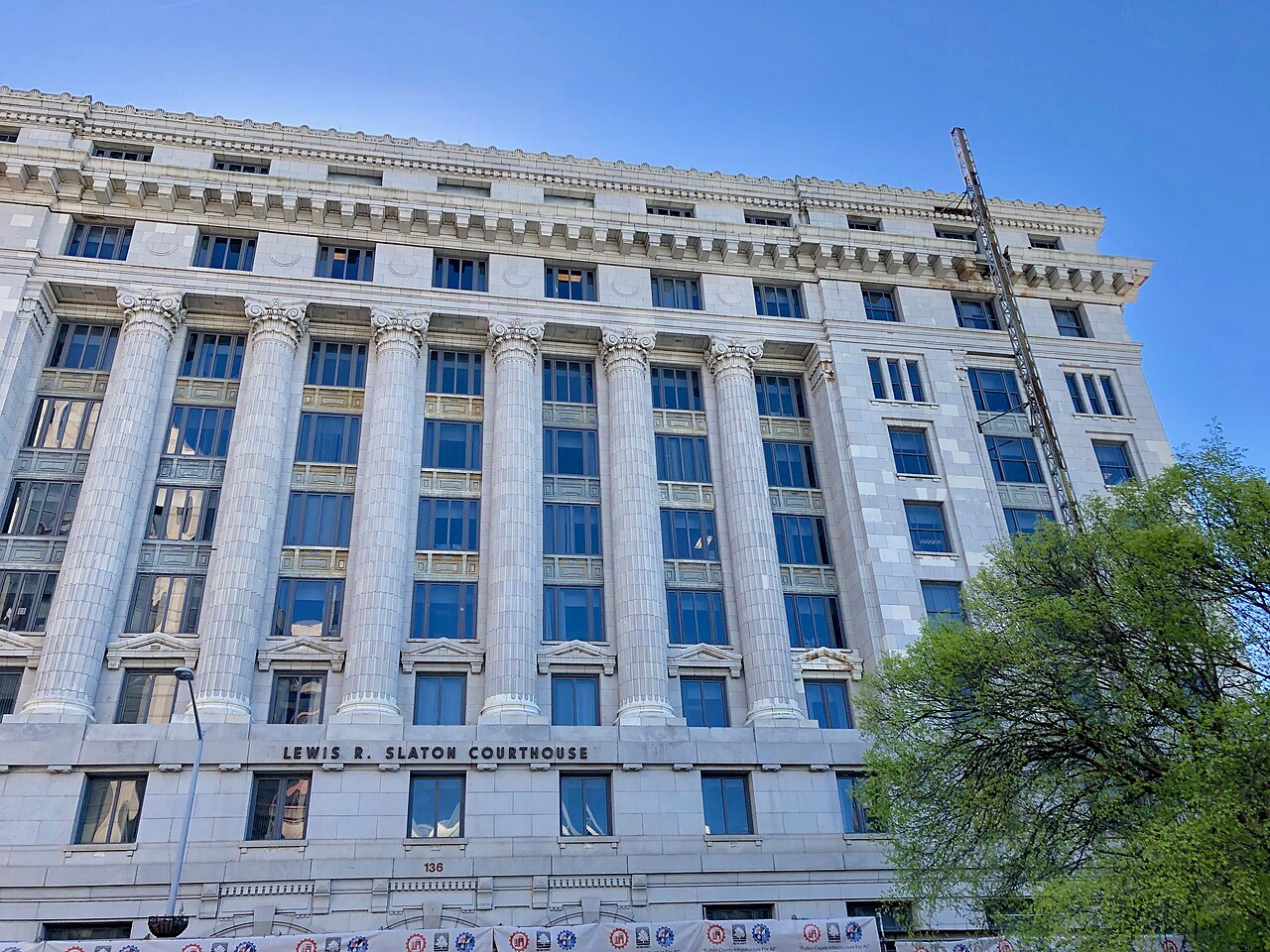
Fulton County Courthouse in Atlanta
Geographic context photograph — not a crime-scene image.
Read the evidence notes
Fulton County Courthouse in Atlanta. Geographic context photograph; not a crime-scene image or evidence of an event shown on the map.
This photograph provides setting or historical context. It is not an authentic crime exhibit. The source and reuse terms are linked below.
Warren LeMay from Cincinnati, OH, United States · Image source · CC0
Buckhead business district in Atlanta
Geographic context photograph — not a crime-scene image.
Read the evidence notes
Buckhead business district in Atlanta. Geographic context photograph; not a crime-scene image or evidence of an event shown on the map.
This photograph provides setting or historical context. It is not an authentic crime exhibit. The source and reuse terms are linked below.
Andrew nyr · Image source · CC BY-SA 4.0
★ Key evidence used in a conviction · ✓ Exclusion or reversal · ◇ Disputed evidence · ⊘ Excluded at retrial · ◆ Identity / investigative finding, not a conviction. A symbol does not mean one item proved the whole case.
Follow the locations
Put the story on the map.
Follow the dated entries, then select an event to find its regional setting. Shared-location pins open a group of events. Evidence symbols identify important findings and their limitations.
Open the map in its own window ↗Sources & further reading
- McIver v. State, S22A0093 — Supreme Court of GeorgiaShooting, disputed expert evidence, financial evidence limits, jury questions and reversal scope. Government judicial opinion.
- Tex McIver pleads guilty to lesser charges — Atlanta Journal-ConstitutionLater plea and eight-year prison sentence with probation; under 200 derived words.
Editorial review: 2026-10-06 · 1656 words