Clara Harris hired a private investigator to learn where her husband was going. On July 24, 2002, the investigator told her that David Harris and Gail Bridges had checked into a hotel in Nassau Bay, Texas. Clara went there with her stepdaughter. Before the evening ended, David was struck by Clara’s Mercedes in the parking lot, and the investigator had recorded part of what happened. [1]
Case brief
Nassau Bay, Texas · 2002
- Recorded outcome
- Clara Harris convicted of murder; twenty years and $10,000 fine, with sudden passion found at punishment; judgment affirmed December 2004; parole release reported May 2018.
Key moments
People in this case
- Clara Harris
Convicted of murdering David Harris
Photo at source · Houston Chronicle · file photograph
That recording became evidence in a murder prosecution. Two other videos, created later by a defense reconstruction expert, became the subject of a different dispute: whether a staged demonstration and an animation could reliably show the car’s path. The case involved a real recording, disputed recollections and competing reconstructions—not one perfect video that answered every question. [1]

Jim Evans · Image source · CC BY-SA 4.0 · Geographic or historical context; not authentic crime evidence. This modern photograph does not reconstruct the 2002 hotel parking-lot layout.

A confrontation at the hotel
After arriving at the Nassau Bay Hilton, Clara and Lindsey Harris approached the front desk. An employee said neither David nor Bridges was registered. They then found Bridges’s Navigator in the parking lot. Clara damaged the vehicle, scratching it and damaging its wipers. Clara and Lindsey called David and said one of his children was ill. [1]
They waited near the entrance and saw David and Bridges emerge from an elevator holding hands. Clara confronted Bridges, and the two women struggled in the lobby. Hotel employees separated them and escorted the people involved toward their vehicles. The court’s account establishes the public confrontation without requiring invented dialogue or thoughts. [1]
Lindsey was David’s daughter and Clara’s stepdaughter. She accompanied Clara in the car and later became a witness at trial. Her presence makes the event more than a dispute between spouses and a third adult. A daughter was placed inside an unfolding confrontation involving her father and then had to describe his death in court. [1]
David’s involvement with Bridges explains the immediate setting. It does not reduce him to an unfaithful husband whose killing can be treated as deserved. The prosecution concerned intentional or knowing homicide. The jury’s later recognition of sudden passion affected punishment; it did not turn the death into a lawful response to infidelity.
The Mercedes moves through the parking spaces
With Lindsey in the passenger seat, Clara backed out, accelerated and drove toward the rear parking area where David and Bridges’s vehicles were located. The Mercedes approached the Navigator and turned into the adjoining space. It struck the Navigator and David, who was standing near its open driver’s door. His exact initial position was not established. [1]
The court described the car crossing two curbed, grassy medians. David’s body came to rest approximately sixty-five feet from the first impact, and Clara drove over it. The opinion preserves uncertainty about whether he became airborne or was initially carried on the hood. That uncertainty should remain visible rather than resolved through an invented cinematic description. [1]
The parking lot was nearly empty. Hotel staff and people at nearby tennis courts saw portions of the incident. Police arrived, summoned emergency medical assistance and took Clara to the station. Their later reconstruction depended on what witnesses had seen, the physical setting and the investigator’s recording. [1]
The footage was described as somewhat poor in quality. It showed at least two full turns in the rear parking area, followed by another half turn before the car stopped next to David. Seeing the car make circles and determining the number of times it crossed a body are related questions, but they are not identical. The defense would focus on that distinction.
Witnesses agreed, and disagreed
At trial, Lindsey and six additional eyewitnesses testified that Clara drove over David multiple times. The witnesses included hotel managers and three people on the tennis courts. Their descriptions differed about the number and sequence. Some described two passes, others three, and one described an additional backward movement. [1]
Those differences are not a reason to erase the testimony or make every count the same. They show that people observing an event from different positions can agree on the central conduct while recalling details differently. The prosecution argued that the combined testimony and footage established the repeated movements and Clara’s criminal responsibility. [1]
The defense called accident reconstructionist Steve Irwin. He argued that Clara could have driven over David only once after the initial collision and that she lacked enough time to stop when she came around the Navigator. His position was presented through testimony, charts and drawings. It was an expert interpretation, not the discovery of new camera footage from the night. [1]
The case therefore had an actual disagreement about the movements. A summary that simply counts the circles and declares a precise number of impacts risks overstating what the recording showed. The jury heard eyewitness evidence and the competing reconstruction, and made the murder finding despite the defense’s account.

Mike Fisher from Webster, TX, USA · Image source · CC BY 2.0 · Geographic or historical context; not authentic crime evidence.

A recording and two reconstructions
To illustrate his conclusions, Irwin prepared two videos. One staged a drive through the parking lot. The other used an animated representation. Clara sought to have both admitted as evidence. The trial judge recognized accident reconstruction as a valid field and accepted Irwin’s qualifications, but questioned the reliability of these particular demonstrations. [1]
The problems were concrete. One omitted a pedestrian entirely. Another placed the person in a position the court considered inappropriate for the disputed impact. The turning movement, tire marks and location of the body did not consistently correspond to the other evidence as the trial judge understood it. The judge thought the videos could mislead the jury. [1]
The appellate court upheld exclusion of the videos. It did not hold that a defense reconstruction can never be admitted. It reviewed the particular materials offered and the trial court’s concerns about how they represented contested facts. A visual can look persuasive while resting on assumptions that the record does not establish. [1]
The original investigator’s recording remained a different kind of evidence: footage of an actual event, despite quality and interpretive limits. The excluded materials were attempts to explain the event afterward. This distinction also governs the article’s gallery. Its diagrams explain the dispute; they are not substitutes for the recording, authentic exhibits or a verified driven route.
The defense was still presented
Clara argued on appeal that excluding the two videos prevented her from offering a meaningful defense. The court rejected that claim because Irwin had testified about the central defense theories and numerous charts and drawings were admitted. The jury heard his opinions about inability to stop and the claimed single later pass. [1]
This matters because the rejected videos can sound like the entire defense being suppressed. The opinion instead describes a restriction on presentation format, while allowing the substantive reconstruction argument. Whether the jury accepted it was another question. The appellate court found no constitutional denial of a complete defense on that record. [1]
Another issue concerned the questioning of Lindsey. Defense counsel sought to impeach her through a friend’s account of a conversation about civil lawyers. The court concluded that the required foundation for a particular follow-up question had not been laid. This was an evidentiary ruling about confronting a witness with a claimed prior statement, not a finding that she had fabricated her testimony. [1]
At the time of trial, Lindsey also had a wrongful-death suit pending against Clara. That fact could bear on how the defense challenged her credibility. It does not establish that the criminal testimony was purchased or coordinated improperly. The criminal verdict and the existence of a civil claim should remain distinct.
Murder, sudden passion and punishment
The jury found Clara guilty of murder. It also found that she acted under the immediate influence of sudden passion arising from an adequate cause. The punishment was twenty years in prison and a ten-thousand-dollar fine. Both findings are recorded at the start of the appellate opinion. [1]
The sudden-passion finding is frequently a source of confusion. Under the Texas framework discussed in the decision, it was a sentencing matter. The court explained that the legislature had changed its treatment from an element of voluntary manslaughter to a factor affecting punishment for murder. The conviction here remained murder. [1]
Clara also requested an instruction on reckless driving. The appellate court rejected it because David had died as a result of her actions; a jury could not rationally convict only of that driving offense on the asserted facts. Recklessness causing a death would implicate a different homicide offense, rather than resolve the case as a traffic violation. [1]
On December 16, 2004, the First Court of Appeals affirmed. The decision addressed seven asserted errors, including the videos, witness impeachment and the order of arguments at punishment. It did not replace the jury’s murder verdict with manslaughter or overturn the sentence.
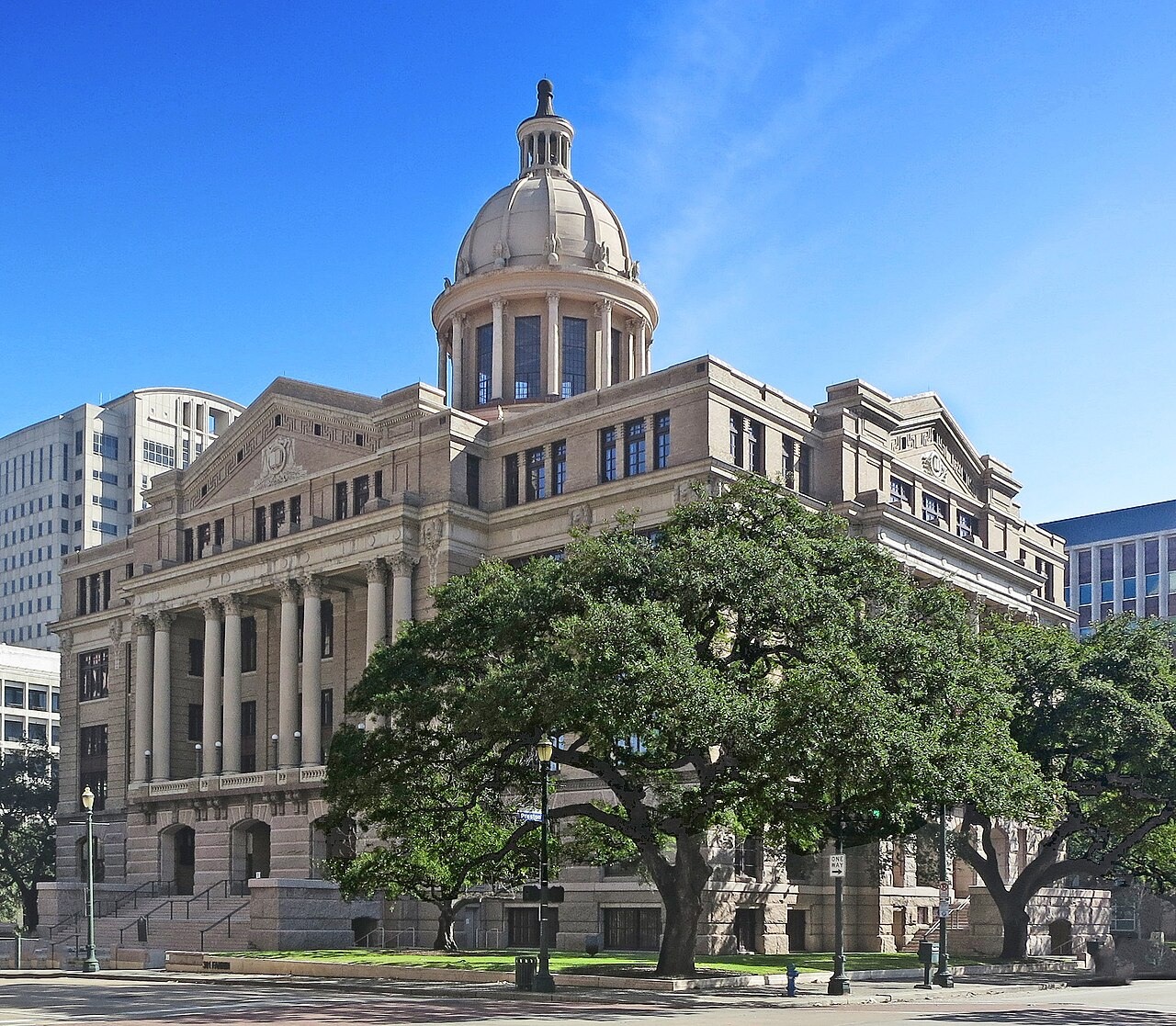
i_am_jim · Image source · CC BY-SA 3.0 · Geographic or historical context; not authentic crime evidence.

Release did not rewrite the verdict
Local reporting documented Clara’s release on parole in May 2018 after approximately fifteen years in prison. That was a later custody milestone, not an acquittal or a determination that the killing had been accidental. The story’s court outcome and its release history answer different questions. [2]
The enduring evidence is a combination: a hired investigator’s recording, witnesses in and around the hotel, the parking-lot geometry and a contested expert reconstruction. The affair explains why the confrontation began. The murder verdict explains how the jury judged the fatal conduct that followed.
David’s daughter was in the passenger seat. That fact gives the parking-lot sequence a human consequence no diagram can reproduce. An accurate account can explain the disputed car movements and the legal treatment of sudden passion while remembering that the evening ended with a father dead and a daughter becoming a witness to his killing.
Look closer · 9 visuals
Inside the evidence.
Open a visual to explore what it contributed to the case—and the limits of what it shows. Photographs, historical reproductions and original illustrations are individually labeled. Open the notes for each image’s source, credit, and limitations; setting photographs do not depict crime scenes.
Two different kinds of video
Original editorial illustration — not an actual evidence photograph or exhibit.
Read the evidence notes
The recording and proposed reconstructions have separate evidentiary histories.
No recreated video is presented as footage of the killing.
Circles do not count every impact
Original editorial illustration — not an actual evidence photograph or exhibit.
Read the evidence notes
Video supplied important evidence without resolving every disputed movement.
No exact collision sequence or single impact count is claimed.
A disputed starting position
Original editorial illustration — not an actual evidence photograph or exhibit.
Read the evidence notes
The placement assumptions affected admissibility of the demonstrations.
Not a scaled parking-lot plan or forensic reconstruction.
Excluded video, admitted defense
Original editorial illustration — not an actual evidence photograph or exhibit.
Read the evidence notes
The court distinguished demonstrations from other ways to present the defense.
Exclusion of a demonstration did not erase all defense evidence.
Murder and sudden passion
Original editorial illustration — not an actual evidence photograph or exhibit.
Read the evidence notes
Sudden passion concerned punishment and did not convert the verdict to manslaughter.
Case-specific legal outcome, not advice.
Parole is a later custody event
Original editorial illustration — not an actual evidence photograph or exhibit.
Read the evidence notes
The dated release report did not exonerate Clara Harris.
No present parole status or completion date is certified.
A modern Hilton hotel in Nassau Bay
Context photograph — not an actual crime exhibit. This modern photograph does not reconstruct the 2002 hotel parking-lot layout.
Read the evidence notes
A modern Hilton hotel in Nassau Bay. Geographic context photograph; not a crime-scene photograph or an original evidence exhibit. This modern photograph does not reconstruct the 2002 hotel parking-lot layout.
Geographic or historical context; not authentic crime evidence. This modern photograph does not reconstruct the 2002 hotel parking-lot layout. The source and reuse terms are linked below.
Jim Evans · Image source · CC BY-SA 4.0
Lakeside houses in Nassau Bay
Context photograph — not an actual crime exhibit.
Read the evidence notes
Lakeside houses in Nassau Bay. Geographic context photograph; not a crime-scene photograph or an original evidence exhibit.
Geographic or historical context; not authentic crime evidence. The source and reuse terms are linked below.
Mike Fisher from Webster, TX, USA · Image source · CC BY 2.0
The historic Harris County Courthouse in Houston
Context photograph — not an actual crime exhibit.
Read the evidence notes
The historic Harris County Courthouse in Houston. Geographic context photograph; not a crime-scene photograph or an original evidence exhibit.
Geographic or historical context; not authentic crime evidence. The source and reuse terms are linked below.
i_am_jim · Image source · CC BY-SA 3.0
★ Key evidence used in a conviction · ✓ Exclusion or reversal · ◇ Disputed evidence · ⊘ Excluded at retrial · ◆ Identity / investigative finding, not a conviction. A symbol does not mean one item proved the whole case.
Follow the locations
Put the story on the map.
Follow the dated entries, then select an event to find its regional setting. Shared-location pins open a group of events. Evidence symbols identify important findings and their limitations.
Open the map in its own window ↗Sources & further reading
- Harris v. State — Texas First Court of AppealsActual judicial opinion: affair and hotel encounter, driving, differing witnesses, investigator video, excluded reconstructions, punishment and affirmance.
- Clara Harris released from prison 15 years after murdering husband with car — Click2HoustonDated parole release only; fewer than 200 derived words. Historical judgment remains separately stated.
Editorial review: 2026-10-06 · 1591 words