Jessica O’Grady’s friends knew her habits. She called, sent messages, returned to the apartment she shared with them and made careful arrangements for her cat whenever she went away. In May 2006, those routines stopped. Her belongings remained, her paycheck went uncollected and calls went straight to voicemail. [1]
Case brief
Omaha, Nebraska · 2006
- Recorded outcome
- Christopher Edwards convicted March 2007; eighty years to life plus consecutive twenty years; 2009 affirmance, 2016 postconviction denial affirmed and 2018 procedural dismissal affirmed.
Key moments
People in this case
- Jessica O’Grady
Murder victim
Photo at source · The Charley Project · identified case photographs 
Eric Nordby An Omaha police detective who interviewed Christopher Edwards during the investigation. Nordby is pictured in his Army Reserve office in 2019.
Official portrait · Sgt. David Lietz, U.S. Army Reserve · U.S. public domainThe appearance of U.S. Department of War (DoW) visual information does not imply or constitute DoW endorsement.
Police never had a recovered body to present at the trial described in the Nebraska Supreme Court’s 2009 opinion. They did have blood in Christopher Edwards’s bedroom and car, a sword, a turned mattress and a store recording of purchases connected to an attempted cleanup. The case asked whether that combination could prove a murder—and later faced a separate challenge after misconduct by a crime-scene investigator was uncovered in other cases. [1][2]

JNOJ1423 · Image source · CC0 · Geographic or historical context; not authentic crime evidence.

The connections that made silence alarming
O’Grady grew up in Omaha and moved into an apartment with friends after high school. She worked at a west Omaha steakhouse. Her aunt, Shauna Stanzel, had helped care for her as a child and spoke with her daily. Friend Holly Stumme had known her since fifth grade. Their contact was frequent enough that an unexplained absence quickly became more than a missed social appointment. [1]
Stumme and roommate Tracy Christianson described O’Grady’s relationship with Edwards, who worked at the same restaurant. He had visited their apartment, including the day before the disappearance. O’Grady talked about him with friends, and on the evening she vanished she was preparing to see him again. [1]
The relationship overlapped another. Michelle Wilkin testified that she had been dating Edwards, that she became pregnant in January 2006 and that their relationship was supposedly exclusive. Two days before O’Grady disappeared, she and Edwards had discussed marriage. Edwards later acknowledged to Wilkin that he had also been involved with O’Grady. [1]
Other testimony concerned Edwards’s belief that he had made someone pregnant. That does not establish O’Grady’s actual pregnancy. The defense disputed the relevance and handling of evidence relating to that issue. The case can describe what witnesses said Edwards believed without converting a contested possibility about the victim into a medically proved fact.
The final calls
On May 10, O’Grady saw her aunt after a softball game. Later, she was at the apartment with friends, using her phone and discussing Edwards. After receiving a call, she showered, got ready and left around eleven or eleven-fifteen. She told her roommates she was going to his residence and would see them afterward. [1]
At approximately eleven-thirty, she spoke to another friend, Keri Peterson, from her car and said she was headed to Edwards’s home. Telephone records placed a call to Peterson at 11:29 p.m. and another to Edwards at 11:48. Those were her final outgoing calls in the records described at trial. [1]
Peterson also received a text roughly an hour after their conversation. The court recounts it as a message from O’Grady’s phone and explains the friends’ interpretation. A message sent from an account or handset does not automatically establish who physically typed it. The telephone evidence supplied the last communications; it did not provide a continuous recording of O’Grady’s movements. [1]
The next day, friends could not reach her. Concern increased on Friday, and relatives contacted police. By Sunday, she had missed another softball game. Her cat and personal possessions were still at the apartment, and her last paycheck remained at the restaurant. Her vehicle was found in a parking lot across from the workplace, approximately a block and a half away. [1]
Edwards’s explanation meets the room
When Stanzel spoke with Edwards, he said he had not heard from O’Grady since May 9 and that he had canceled plans for May 10. Police interviewed him as part of contacting people who had recently seen or spoken with her. He agreed to a search of the bedroom where he lived in his aunt’s house. [1]
As a detective approached the bed, Edwards hesitated about police checking that area. Officers suggested that O’Grady might have left a note beneath the mattress, and he permitted the search to continue. Investigators saw blood spatter on the nightstand, headboard, clock radio and ceiling. He attributed some stains to a cut wrist and a small mattress stain to an intimate encounter. [1]
The underside of the mattress told a different story. It had a large, damp bloodstain covering much of that surface. More staining appeared on bedding, furniture and other items. Some ceiling stains had been covered with white paint. The room did not simply contain one unexplained spot that could be interpreted in isolation. [1]
Police found a short sword in the closet with blood on it. In Edwards’s car and the adjoining garage, they found additional bloodstained items, including towels and traces in the trunk. These discoveries extended the investigation beyond the bed. Their evidentiary value depended on testing, collection records and how the items related to each other.

JonClee86 at en.wikipedia · Image source · CC BY-SA 3.0 · Geographic or historical context; not authentic crime evidence.

A receipt and a recording
Inside a trash bag with bloodstained towels was a drugstore receipt. Store video showed Edwards buying poster paint, white shoe polish and correction fluid at 7:41 p.m. on May 11, the day after O’Grady’s last recorded calls. The poster paint was chemically identical to paint found on the ceiling. [1]
The purchase evidence supplied a documented action after the disappearance. Its significance came from the covered stains and the location of the receipt with stained towels. Buying ordinary household products is not criminal by itself. In this record, the prosecution argued that the purchases helped explain an effort to conceal what had happened in the room. [1]
DNA profiles from blood on multiple surfaces, the weapon and the vehicle were consistent with O’Grady’s profile. The opinion gives very low probabilities of an unrelated person sharing particular profiles, varying by sample. Those figures addressed source attribution. They were not numerical probabilities that Edwards was guilty, and they did not identify a time at which each stain was deposited. [1]
Forensic consultant Stuart James interpreted the mattress stain as saturation from a substantial bloodshed event on or near the bed. He described other patterns as consistent with swings of a blood-wet object and transfer through contact. This was expert reconstruction presented to the jury. It did not amount to an eyewitness account of the killing. [1]
Proving a death without the person’s body
The prosecution charged Edwards with second-degree murder and use of a deadly weapon. A jury convicted him in March 2007. He received eighty years to life for murder and a consecutive twenty-year weapon sentence. His direct appeal challenged, among other things, whether the evidence could prove that O’Grady was dead when her body had not been found. [1][2]
The court considered the evidence cumulatively. The blood evidence, possible weapon, concealment and vehicle traces accompanied a complete break in O’Grady’s ordinary life. Her family and friends had not heard from her, her possessions remained and her financial and phone activity had stopped. The prosecution’s proof was broader than absence alone. [1]
Edwards sought a jury instruction using a statutory definition of death based on irreversible bodily functions. The Nebraska Supreme Court rejected applying that definition as he proposed in this homicide prosecution. It also rejected the claim that the state needed direct observation of those functions or a death certificate to establish death through circumstantial evidence. [1]
On July 10, 2009, the court affirmed. The ruling demonstrates that a murder can be proved without recovering remains. It does not mean every disappearance with unexplained blood is automatically a homicide. This verdict rested on the particular combination the jury heard, and the appellate court’s sufficiency review of that record.
The investigator whose other cases changed the question
Later events required another look at the evidence. David Kofoed, a former supervisor in the Douglas County crime-scene division, was found to have fabricated or planted evidence in other murder investigations. Edwards alleged that similar wrongdoing had occurred in O’Grady’s case and that his lawyer’s relationship with Kofoed created a conflict. [2]
The courts did not dismiss the concern simply because there had already been a conviction. In 2012, the Nebraska Supreme Court ordered an evidentiary hearing on the fabrication and actual-conflict claims. Hearings took place over several dates in 2013 and 2014. This was a limited remand for inquiry, not a decision vacating the murder conviction. [2]
In July 2016, the Supreme Court affirmed the denial of relief after the hearing. The judges distinguished established wrongdoing in other cases from proof that evidence in this case was fabricated. They upheld the findings rejecting Edwards’s allegations and the claim of an actual conflict affecting his representation. [2]
That history belongs beside the forensic evidence, rather than in a footnote that readers never see. An investigator’s proven misconduct can create a serious reason to examine collection and testing. It does not establish that every case involving that investigator must have been falsified. Here, the relevant claims received a hearing and were rejected.
Jon Clee / JonClee86 at en.wikipedia · Image source · CC BY-SA 3.0 · Geographic or historical context; not authentic crime evidence.

Another motion and an incomplete family ending
A later postconviction motion produced a further appeal in 2018. The Nebraska Supreme Court affirmed its dismissal under the statutory time limit. A procedural ruling of that kind does not independently retry every factual claim. The direct conviction, the hearing on fabrication and the later deadline ruling are distinct legal events. [3]
The reviewed 2009 record states that O’Grady’s body had not been found. This article does not turn that historical statement into a certification of every search or recovery development through the present. The absence of remains at trial was central to the legal question, and it left the people who knew her with a different kind of unfinished ending from a completed prosecution.
The most revealing early evidence came from those people. They knew the daily calls, the softball games, the work and the care for a cat. Their concern helped establish that the disappearance was an abrupt break in a life with strong connections. The later physical evidence supported a murder verdict against Edwards, while subsequent scrutiny tested whether that evidence could still be trusted. Both strands are necessary to tell Jessica O’Grady’s story accurately.
Look closer · 9 visuals
Inside the evidence.
Open a visual to explore what it contributed to the case—and the limits of what it shows. Photographs, historical reproductions and original illustrations are individually labeled. Open the notes for each image’s source, credit, and limitations; setting photographs do not depict crime scenes.
Routines that did not resume
Original editorial illustration — not an actual evidence photograph or exhibit.
Read the evidence notes
Friends’ knowledge of Jessica’s habits helped establish concern about her disappearance.
Not invented personal photographs or a reconstruction of her thoughts.
The turned mattress
Original editorial illustration — not an actual evidence photograph or exhibit.
Read the evidence notes
The bedroom evidence supported a lethal event and attempted concealment.
An explanatory guide, not a photograph of the actual mattress.
The receipt and the ceiling paint
Original editorial illustration — not an actual evidence photograph or exhibit.
Read the evidence notes
A recording and chemical comparison connected purchases to scene evidence.
Not an authentic store receipt or surveillance still.
A verdict without recovered remains
Original editorial illustration — not an actual evidence photograph or exhibit.
Read the evidence notes
The court upheld this record’s proof of death despite no recovered body at trial.
No current recovery status or rule for all missing-person cases is asserted.
Misconduct elsewhere required inquiry
Original editorial illustration — not an actual evidence photograph or exhibit.
Read the evidence notes
Proven misconduct in other investigations prompted review but did not establish planting here.
The gallery does not label contested evidence as proven fabrication.
Three different appellate tasks
Original editorial illustration — not an actual evidence photograph or exhibit.
Read the evidence notes
The reviewed decisions address different questions and should not be conflated.
Procedural dismissal is not an independent factual retrial.
Omaha skyline beyond Gene Leahy Mall
Context photograph — not an actual crime exhibit.
Read the evidence notes
Omaha skyline beyond Gene Leahy Mall. Geographic context photograph; not a crime-scene photograph or an original evidence exhibit.
Geographic or historical context; not authentic crime evidence. The source and reuse terms are linked below.
JNOJ1423 · Image source · CC0
Douglas County Courthouse in Omaha
Context photograph — not an actual crime exhibit.
Read the evidence notes
Douglas County Courthouse in Omaha. Geographic context photograph; not a crime-scene photograph or an original evidence exhibit.
Geographic or historical context; not authentic crime evidence. The source and reuse terms are linked below.
JonClee86 at en.wikipedia · Image source · CC BY-SA 3.0
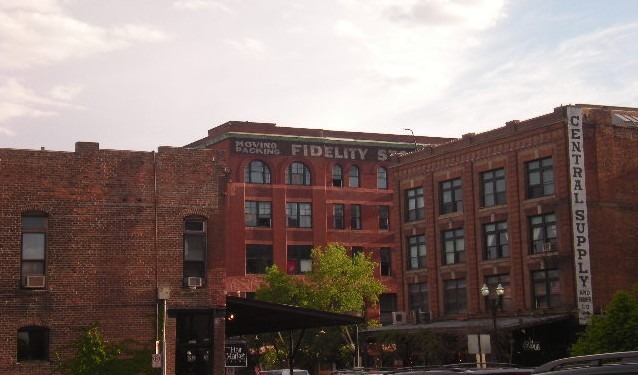
Omaha’s Old Market district
Context photograph — not an actual crime exhibit.
Read the evidence notes
Omaha’s Old Market district. Geographic context photograph; not a crime-scene photograph or an original evidence exhibit.
Geographic or historical context; not authentic crime evidence. The source and reuse terms are linked below.
Jon Clee / JonClee86 at en.wikipedia · Image source · CC BY-SA 3.0
★ Key evidence used in a conviction · ✓ Exclusion or reversal · ◇ Disputed evidence · ⊘ Excluded at retrial · ◆ Identity / investigative finding, not a conviction. A symbol does not mean one item proved the whole case.
Follow the locations
Put the story on the map.
Follow the dated entries, then select an event to find its regional setting. Shared-location pins open a group of events. Evidence symbols identify important findings and their limitations.
Open the map in its own window ↗Sources & further reading
- State v. Edwards — Nebraska Supreme CourtFamily and friends, last communications, searches, blood and DNA, paint receipt, expert testimony, murder without recovered body and direct affirmance.
- State v. Edwards — Nebraska Supreme Court postconviction appeal2012 hearing remand, 2013–2014 hearings, Kofoed’s other misconduct, rejection of fabrication and conflict claims.
- State v. Edwards — Nebraska Supreme Court later motionLater motion and statutory time-limit affirmance; date restricted to verified year in this package.
Editorial review: 2026-10-06 · 1670 words