The violin was almost three centuries old. The attack that took it from Frank Almond happened after a concert, as the Milwaukee Symphony Orchestra's concertmaster made his way to his car.
Case brief
Milwaukee, Wisconsin · 2014
- Recorded outcome
- Both defendants pleaded guilty in 2014; Salahadyn's conviction and sentence were affirmed in March 2016.
Key moments
People and case photographs
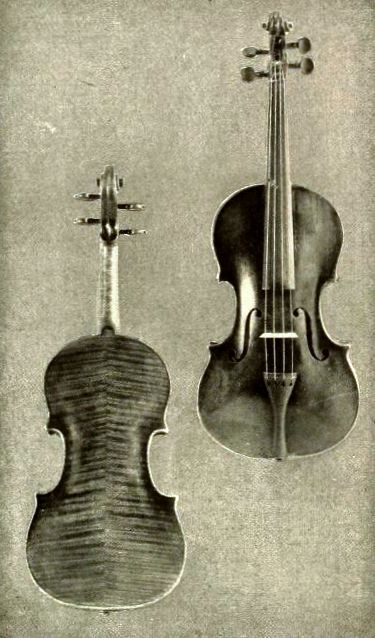
The Lipinski Stradivarius Front and back views of the violin stolen from Frank Almond in 2014, published in Shadowland in January 1923.
Archival photograph · Unknown photographer · Shadowland, January 1923, p. 58 · U.S. public domain- Frank Almond
Violinist from whom the Lipinski Stradivarius was stolen
Photo at source · Milwaukee Magazine · profile photographs
On January 27, 2014, an assailant used a stun gun against Almond and stole the case containing the Lipinski Stradivarius. Within hours, police found the discarded case. The violin was gone. [1] [3]
The theft placed an instrument valued at more than $5 million outside the careful system that normally protected it. It also left investigators with a practical question: what could a robber do with something this recognizable?
A working instrument
Antonio Stradivari made the violin in 1715. It later became known as the Lipinski, after the violinist Karol Lipinski. At the time of the robbery it was on loan to Almond from an anonymous donor, and he had played it since 2008, according to the FBI's account.
The loan meant the violin was being heard, not simply stored. On the night of the attack Almond had performed at Wisconsin Lutheran College. The ordinary act of leaving a venue with an instrument created the opportunity for the robbery.
Its exceptional value could make the case sound like an adventure about an object. The attack was also an assault on the person carrying it. Recovering the instrument would address the loss of property; it would not erase what happened to Almond in the parking lot.
Two paths toward the suspects
The investigation combined physical evidence with information from the public.
Evidence associated with the stun gun allowed investigators to trace the weapon through its manufacturer to a purchaser, Universal Knowledge Allah, a Milwaukee barber. Separately, a tip prompted by a $100,000 reward directed attention toward Salah I. Salahadyn. The FBI's historical account uses a variant spelling of Salahadyn's surname; the Wisconsin appellate court identifies him as Salah I. Salahadyn. [1] [2]
The two leads were useful for different reasons. The weapon trace connected an item used in the attack to a person. The tip supplied another name for investigators to examine. Neither required the violin to appear openly for sale.
Both men were arrested about a week after the robbery. At that point the missing instrument remained the immediate problem. An arrest could help establish responsibility, but police still had to locate the violin and determine whether it had survived.
Nine days
Nine days after the attack, Salahadyn led investigators to a house where they found the violin in an attic. It was wrapped in a baby blanket inside a suitcase. Two bows were recovered with it.
The FBI described the instrument as being in excellent condition. After a violent theft and an uncertain interval, the recovery avoided a second potential loss: permanent damage to an irreplaceable working instrument. [1]
The hiding place was ordinary enough to underscore the vulnerability. An artifact with centuries of documented history had been reduced to something concealed among household belongings. Its value offered no automatic protection from mishandling.
An FBI Art Crime Team investigator later suggested that the aim may have been to collect reward money rather than sell the violin. That was the agency's interpretation, not a motive independently established by a jury. The confirmed sequence was narrower: the violin was stolen, investigators identified suspects, and Salahadyn helped return it.
The return was part of the deal
The Wisconsin Court of Appeals later described the agreement behind Salahadyn's plea. He would return the violin and plead guilty to one count of robbery as a party to a crime. In exchange, the prosecutor would not bring additional charges under that agreement. [2]
Salahadyn argued that the prosecutor had not honored the bargain because a more serious armed-robbery charge could follow if he declined to plead guilty and chose trial. [2]
The appellate court rejected that argument. The agreement required both the return of the instrument and the guilty plea. Returning the violin alone did not obligate the state to preserve every term of the bargain if he rejected the plea.
The court also examined whether the plea had been entered knowingly and voluntarily. It reviewed the trial judge's explanation of rights, penalties and the agreement, as well as Salahadyn's acknowledgment of the complaint's facts. The court found no arguable basis for overturning the plea.
Two investigations had to meet
The search for the instrument and the identification of the robbers ran alongside each other. Finding the empty case within hours confirmed that the violin had been separated from its ordinary protection. Tracing the weapon's purchase supplied a person investigators could question. A tip supplied another lead. Arresting the suspects still left the violin and its two bows missing. These were successive problems, not one discovery that solved everything at once. [1]
The recovery scene was modest compared with the instrument's reputation. An agent needed a borrowed ladder to reach an attic crawl space. The violin and bows were inside an old suitcase, wrapped in a baby blanket. The FBI reported that the violin was in excellent condition. The gallery's suitcase is a generic drawing, included to explain that chain of recovery; it is not a photograph of the actual container or the home. [1]
What the appeal reveals about the plea
The appellate order describes the judge asking whether Salahadyn had reviewed the complaint and accepted its facts as the basis for his plea. He said he had. The court also warned that sentencing recommendations did not bind the judge. That exchange mattered when the later appeal examined whether his decision had been knowing and voluntary. [2]
At sentencing, the return of the violin counted in his favor. Other circumstances pulled the other way. The judge criticized his explanation that he wanted money to help others, his involvement of additional people and his treatment of Almond. The record therefore gives recovery two distinct roles: it restored the instrument to its musical life, and it became a mitigating circumstance in a case that still involved an assault. The appellate court's March 2016 decision upheld the judgment after reviewing that balance and the plea proceedings. [2]
What the sentences actually meant
Allah pleaded guilty in May 2014. Contemporary reporting in The Strad described his sentence as three and a half years in prison followed by three and a half years of extended supervision.
Salahadyn received seven years of initial confinement and five years of extended supervision. Together those components made a twelve-year Wisconsin sentence; they did not mean twelve years behind bars. [3] [2]
The sentencing court considered his assistance in recovering the violin. It also considered the attack, his involvement of others and the way he rationalized the crime. Returning valuable property was a mitigating fact, but it did not remove the violence from the offense.
On March 14, 2016, the Court of Appeals affirmed the judgment after reviewing both counsel's no-merit report and Salahadyn's own arguments. That ruling established the result of this appeal, rather than a claim about every possible later filing.
The Lipinski case moved unusually quickly from theft to recovery. A traceable weapon and a public tip helped identify suspects; a negotiated return located the instrument. The result preserved the violin's future as a musical instrument while leaving the assault, and the responsibility for it, firmly in the criminal record.
Look closer · 3 visuals
Inside the evidence.
Open a visual to explore what it contributed to the case—and the limits of what it shows. Photographs, historical reproductions and original illustrations are individually labeled. Open the notes for each image’s source, credit, and limitations; setting photographs do not depict crime scenes.
A violin with a musical life
Archival photograph of the exact violin, published in 1923.
Read the evidence notes
The image shows both sides of the Lipinski. Frank Almond had played the instrument since 2008 when it was stolen in 2014.
The photograph predates the robbery by more than 90 years.
Source 1 ↗ · Unknown photographer · Shadowland, January 1923, p. 58 · Image source · U.S. public domain


A purchase trace supplies a name
Original editorial illustration — not an actual evidence photograph or exhibit.
Read the evidence notes
Investigators traced the weapon’s purchase to Allah while a separate tip concerned Salahadyn.
Generic transaction symbol; no weapon instructions or original sales record shown.
The suitcase in the attic
Original editorial illustration — not an actual evidence photograph or exhibit.
Read the evidence notes
Salahadyn led investigators to the violin and two bows nine days after the robbery.
Generic suitcase, not the actual container or a view of a private home.
★ Key evidence used in a conviction · ✓ Exclusion or reversal · ◇ Disputed evidence · ⊘ Excluded at retrial · ◆ Identity / investigative finding, not a conviction. A symbol does not mean one item proved the whole case.
Follow the locations
Put the story on the map.
Follow the dated entries, then select an event to find its regional setting. Shared-location pins open a group of events. Evidence symbols identify important findings and their limitations.
Open the map in its own window ↗Sources & further reading
- FBI history: Stradivarius Violin CasesAttack, weapon trace, reward tip, nine-day recovery, FBI's motive theory and historical outcomes.
- State v. Salah I. Salahadyn, 2015AP1962-CRNMCourt spelling; plea, negotiated recovery, sentence components, defense challenges and affirmance.
- Mastermind of Lipinski Stradivarius theft receives seven-year prison sentenceJanuary 27 attack date, Allah's three-and-a-half-year confinement and supervision, and dated sentencing coverage.
Editorial review: 2026-09-30 · 1207 words