On January 17, 1950, masked men entered Brink’s Boston premises and interrupted employees securing the day’s collections. Within minutes, they had taken more than $1.2 million in cash and about $1.5 million in checks and other securities.
Case brief
Boston, Massachusetts · 1950
- Recorded outcome
- O'Keefe pleaded guilty in 1956; eight defendants convicted and sentenced that year; appeals unsuccessful in 1959.
Key moments
People and case photographs
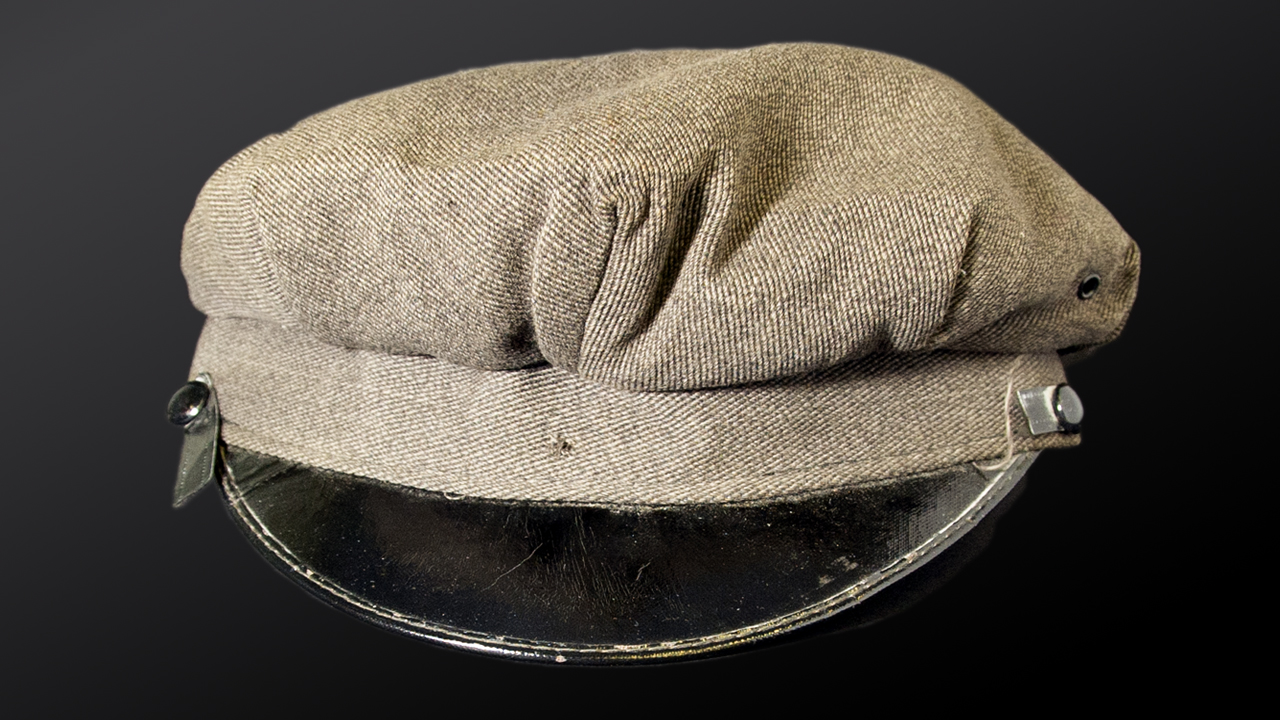
The cap left at Brink’s The FBI photographed the chauffeur’s cap left at the scene of the 1950 robbery. Investigators examined it but did not identify the robbers from the cap.
Photograph of recovered evidence · Federal Bureau of Investigation · Public Domain Mark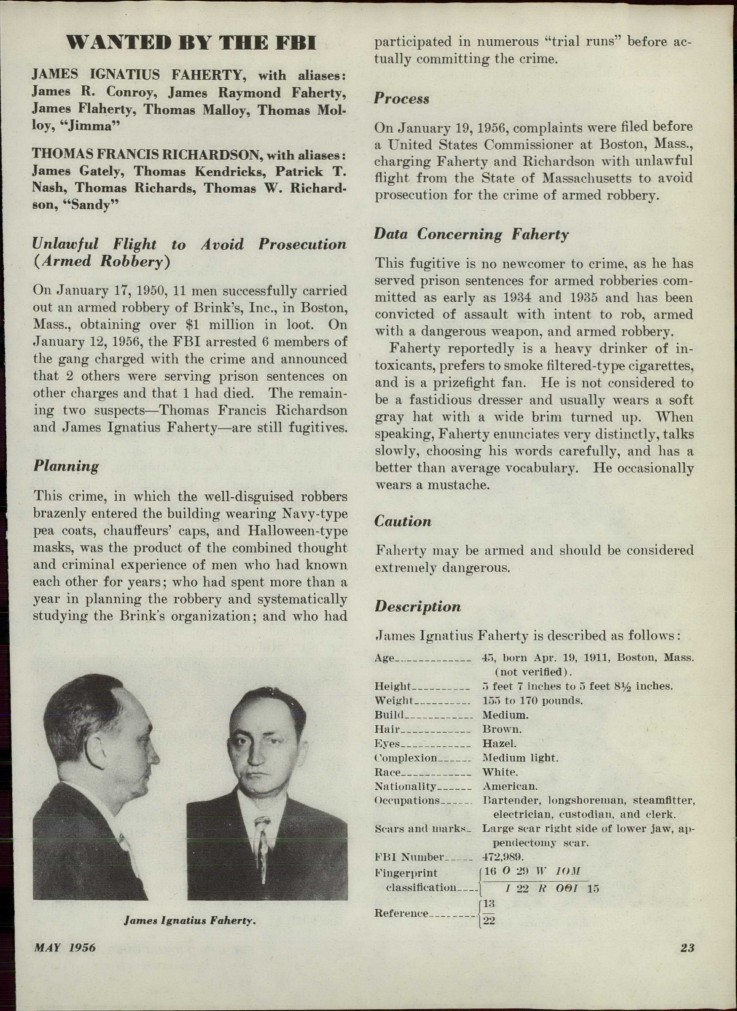
James Ignatius Faherty The FBI published this notice while Faherty was a fugitive. He was later convicted in the 1950 Brink’s robbery.
Archival FBI wanted notice · FBI Law Enforcement Bulletin · May 1956, p. 23 · U.S. public domain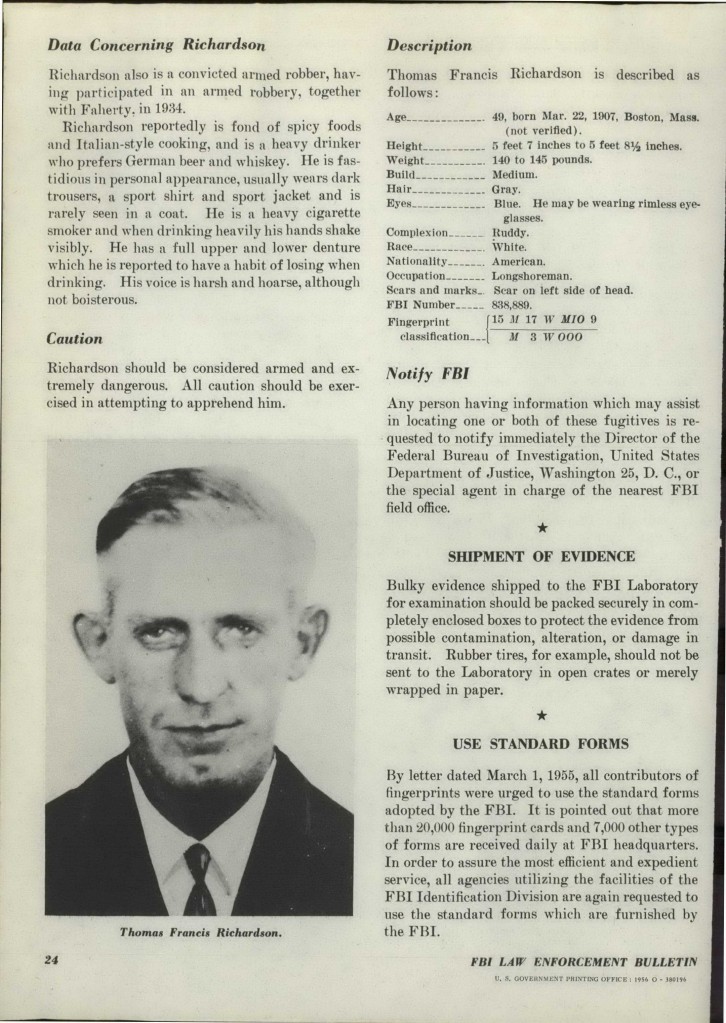
Thomas Francis Richardson Richardson was arrested with Faherty in May 1956 and later convicted in the Brink’s robbery.
Archival FBI wanted notice · FBI Law Enforcement Bulletin · May 1956, p. 24 · U.S. public domain- Anthony Pino
Convicted in the Brink’s robbery
Photo at source · FBI · archival mugshot
The robbery appeared disciplined and extensively prepared. The investigation that followed was anything but simple. Physical clues, suspicious vehicles and plausible suspects did not quickly produce a prosecutable case.
The break came almost six years later, when Joseph “Specs” O’Keefe decided to describe the robbery and identify the men involved. The secret had survived the first search for evidence. It did not survive years of imprisonment, disputes and violence among the people who shared it. [1]
The employees on the floor
The robbers encountered five employees in the vault area of the building on Prince Street. They held them at gunpoint, bound them and covered their mouths.
The disguises made identification difficult. The men did little talking and appeared familiar with the premises. A buzzer briefly raised the possibility that someone else would enter, but the robbery continued.
The amount stolen requires a distinction. More than $1.2 million was currency; the remainder consisted of checks and other securities. Adding the figures describes the overall haul, but it does not mean every dollar was spendable cash.
The crime became famous for its scale and precision. For the employees, it was an armed robbery in a workplace. The absence of a fatality does not erase that threat. [1]
Clues that did not immediately connect
Police and FBI agents recovered material used to restrain the employees and a chauffeur-style cap left at the scene. They recorded descriptions and serial numbers of weapons taken during the robbery.
One stolen gun later turned up near the Mystic River. Investigators also found pieces of a disassembled truck in Stoughton. The vehicle resembled one seen near Brink’s and had been reported stolen before the robbery.
These were meaningful discoveries, but they did not instantly identify the people responsible. Investigators followed the materials and vehicle history, interviewed witnesses and examined possible connections. Some paths ended without results.
The cap remains an artifact associated with the case, a tangible reminder that physical evidence can survive even when its immediate investigative value is limited. [1] [2]
Suspicion without an indictment
Investigators developed a group of suspects, including Anthony Pino and O’Keefe. The FBI’s institutional history describes scrutiny of their associations and accounts of the evening.
A weak alibi was not enough. The disguised intruders had not been positively identified by the employees, and potential witnesses were unwilling to provide the missing evidence.
A federal grand jury heard evidence beginning in late 1952. In January 1953, it returned no indictments. The account emphasizes gaps in identification and testimony.
That failed stage is important to the history. Investigators believed they were looking at the right people, but belief and admissible proof were different things. The inquiry continued. [1]
The cost of keeping the secret
O’Keefe and Stanley Gusciora were arrested in Pennsylvania on unrelated criminal matters in 1950. Their imprisonment changed the relationships among the suspected robbers.
O’Keefe needed money for legal expenses. He became increasingly angry at associates he believed were withholding support while enjoying freedom.
The FBI history also records attempts on his life in 1954. He survived being wounded. Those attacks intensified the break between him and the people who had once depended on his silence.
January 1956
On January 6, 1956, O’Keefe began giving investigators a detailed account.
He described the group’s planning, its familiarity with the building and the participants’ roles. Agents checked what they could against information already developed during the long investigation.
That corroboration mattered. O’Keefe was not a neutral observer. He was admitting involvement in the robbery while implicating former associates with whom he had serious disputes. His account required checking, not automatic acceptance.
His cooperation nevertheless filled gaps that earlier evidence had left open. On January 18, he pleaded guilty to the armed robbery.
The case’s decisive turn therefore came through a participant who had incentives both to conceal and, later, to disclose. Understanding those changing incentives explains more than a legend about flawless planning suddenly undone by a single careless mistake. [1]
Some money returns
In June 1956, investigators recovered a portion of the stolen currency through a separate trail involving money being passed and a hiding place in Boston.
Some bills could be identified as part of the Brink’s haul. Their deteriorated condition complicated the examination and counting.
The recovery did not account for most of the cash. The FBI history records more than $1.15 million still missing after the discoveries it describes. It would be inaccurate to imply that solving the robbery also restored the entire loss.
Money recovery and criminal prosecution proceeded as related but different tasks. One could succeed more fully than the other. [1]
The money looked wrong for the wrong reason
In Baltimore on June 3, 1956, suspicion fell on worn, musty bills being passed by a visitor from Boston. Their appearance suggested counterfeit currency. A Secret Service examination found that they were genuine. That did not end the inquiry: serial numbers allowed the FBI to ask where this genuine money had come from. Of the $4,822 found in the man's possession, agents identified $4,635 as proceeds of the Brink's robbery. [1]
The man's first explanation was a lucky discovery while working on a house foundation. Questioning produced a different account involving a Boston office, a wall compartment and packages of old bills. The distinction mattered. Looking unusual had attracted attention, but recorded identifiers connected the cash to a particular theft committed more than six years earlier. [1]
On June 4, a search of the Tremont Street offices found a picnic cooler behind a partition. It held more than $57,700, of which $51,906 could be identified as Brink's money. Those are separate figures: the total cash in the container and the portion affirmatively linked to the robbery. The subsequent possession charges were also separate from the prosecution of the original robbery. [1]
The clues that had stayed silent
The recovered cap, rope and tape had looked promising in 1950 but had not identified the gang. Investigators also pursued spending rumors that proved misleading. A man in New Jersey who attracted attention for new cars and nightclub spending was eliminated as a suspect. The contrast with the Baltimore bills is instructive: conspicuous money was a lead, while identifiers supplied a checkable connection. The evidence gallery marks the traced currency as important corroboration and keeps the abandoned cap labeled as context. [1]
The trial and the verdicts
Gusciora died before trial. Eight remaining defendants went before a jury in 1956, with O’Keefe serving as a principal witness.
The proceedings involved extensive jury selection and testimony from more than 100 witnesses. The jury convicted all eight in October. The court imposed life terms, along with additional sentences on other counts.
State appellate challenges failed in 1959, and the U.S. Supreme Court declined further review that November.
The legal outcome ended the claim that the robbers had permanently escaped responsibility. It did not answer every question about the missing money or undo the danger to the employees. [1]
What the plan could not control
The Brink’s robbery depended on disciplined preparation and coordinated action. Its concealment depended on something less stable: people remaining loyal over years of separate troubles.
The investigation’s long duration is part of the story, not a gap to skip. Agents had clues without enough proof, a grand jury without indictments and suspects who would not talk. O’Keefe’s cooperation became useful because earlier work made parts of it testable.
The robbery’s lasting twist is that the group’s shared secret became a source of pressure inside the group. The men had planned for access to a building. They had not secured one another’s silence for the rest of their lives.
Look closer · 3 visuals
Inside the evidence.
Open a visual to explore what it contributed to the case—and the limits of what it shows. Photographs, historical reproductions and original illustrations are individually labeled. Open the notes for each image’s source, credit, and limitations; setting photographs do not depict crime scenes.
The cap that did not name a robber
FBI photograph of the actual cap recovered at the scene.
Read the evidence notes
The cap was one of the few physical clues left behind. Its examination did not establish who wore it.
The FBI photographed the preserved artifact for its collection.
Source 1 ↗ · Source 2 ↗ · Federal Bureau of Investigation · Image source · Public Domain Mark

Genuine money, identifiable theft
Original editorial illustration — not an actual evidence photograph or exhibit.
Read the evidence notes
Recorded identifiers linked money found in Baltimore to the robbery.
No actual currency or serial numbers reproduced.
An insider breaks the silence
Original editorial illustration — not an actual evidence photograph or exhibit.
Read the evidence notes
O’Keefe’s cooperation supplied an account investigators could compare with other evidence.
Not an authentic statement or a claim that every assertion stood without corroboration.
★ Key evidence used in a conviction · ✓ Exclusion or reversal · ◇ Disputed evidence · ⊘ Excluded at retrial · ◆ Identity / investigative finding, not a conviction. A symbol does not mean one item proved the whole case.
Follow the locations
Put the story on the map.
Follow the dated entries, then select an event to find its regional setting. Shared-location pins open a group of events. Evidence symbols identify important findings and their limitations.
Open the map in its own window ↗Sources & further reading
- FBI history: Brink's RobberyRobbery, investigative leads, grand jury, O'Keefe cooperation, recovery and convictions.
- FBI artifact record: Brink's Robbery CapSurviving physical artifact associated with the robbery.
Editorial review: 2026-09-30 · 1314 words